

Craig Sheffer has spent much of his career working in front of motion-picture cameras, experiencing the relationship between lighting, cinematography and performance from inside the frame. As an actor, writer, producer and director, he brings a perspective shaped by decades of filmmaking, including his starring role in Robert Redford's A River Runs Through It (1992), which won the Academy Award for Best Cinematography.
What makes Craig's perspective particularly interesting is that he is also a photographer. He understands lighting not only as something that shapes a performance, but as a creative decision made by the person behind the camera.
Craig and I have been friends for many years, sharing an interest in photography, cameras and the visual language of cinema. We've travelled and photographed together, including a journey through the American West revisiting landscapes connected to A River Runs Through It. Our conversations frequently return to the relationship between light, composition and the decisions that give a photograph its character.
For The Cinematic Notebook at Liquid Light Lab, I wanted to explore these ideas from Craig's perspective, drawing on his experience working alongside accomplished cinematographers and his own practice as a photographer.
We discuss the discipline of directional lighting, how a subject responds to the environment created around them, and what happens when lighting becomes an integral part of the storytelling rather than simply illuminating the scene.
The conversation also explores something particularly relevant to our work at Liquid Light Lab: what photographers expect from the people entrusted with developing and scanning their film.
A photographer can spend considerable time choosing the right light, exposure and composition. The decisions made in processing and digitisation should respect that work, allowing the intentions behind the original exposure to carry through to the finished image.
Craig's observations bring these different stages of photography together, from the experience of standing in front of a motion-picture camera to the importance of consistency and trust when the exposed film reaches the lab.
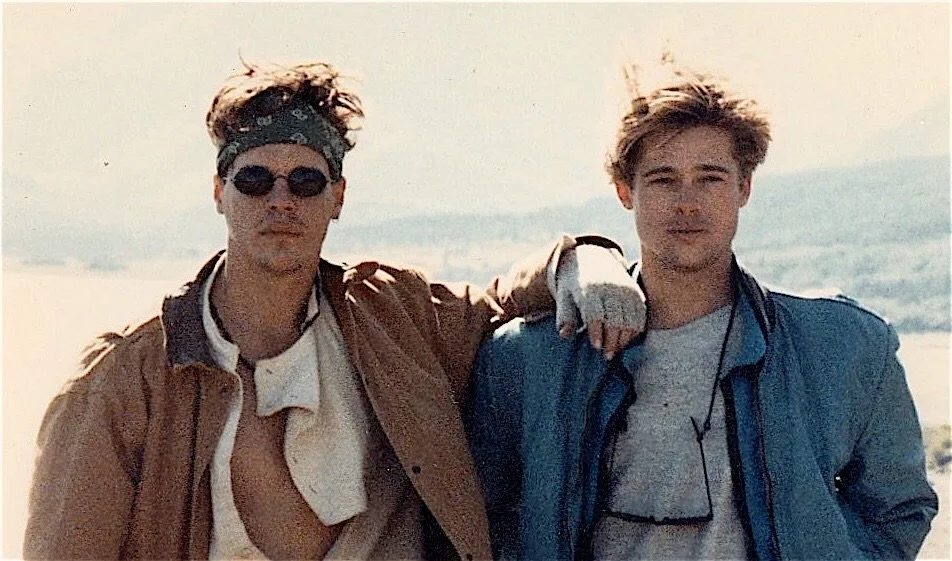
Craig Sheffer and Brad Pitt during production of A River Runs Through It (1992), directed by Robert Redford and photographed by Philippe Rousselot.
The film later won the Academy Award for Best Cinematography.
The conversation that follows explores how lighting decisions influence both photography and performance. Craig draws on his experience of working with cinematographers such as Philippe Rousselot, considers the discipline behind carefully constructed images, and explains why consistency matters throughout the photographic process.
For photographers working with film, these observations extend beyond the moment of exposure. Understanding light is fundamental to making the negative; understanding development and scanning is equally important when interpreting and presenting the photograph.
You’ve maintained a lifelong practice as a photographer alongside your work as an actor. What drew you to making photographs yourself, rather than remaining only in front of the camera?
As an actor you’re inside someone else’s frame all the time. The camera, the lens, the light — that’s all decided before you get there. With photography, I get to build something from scratch. It feels similar to acting in that you’re telling a story, but you’re doing it from the outside in instead of the inside out. I love making my own stories in photographs, writing scripts, and movies. Whatever I’m making I enjoy the process.
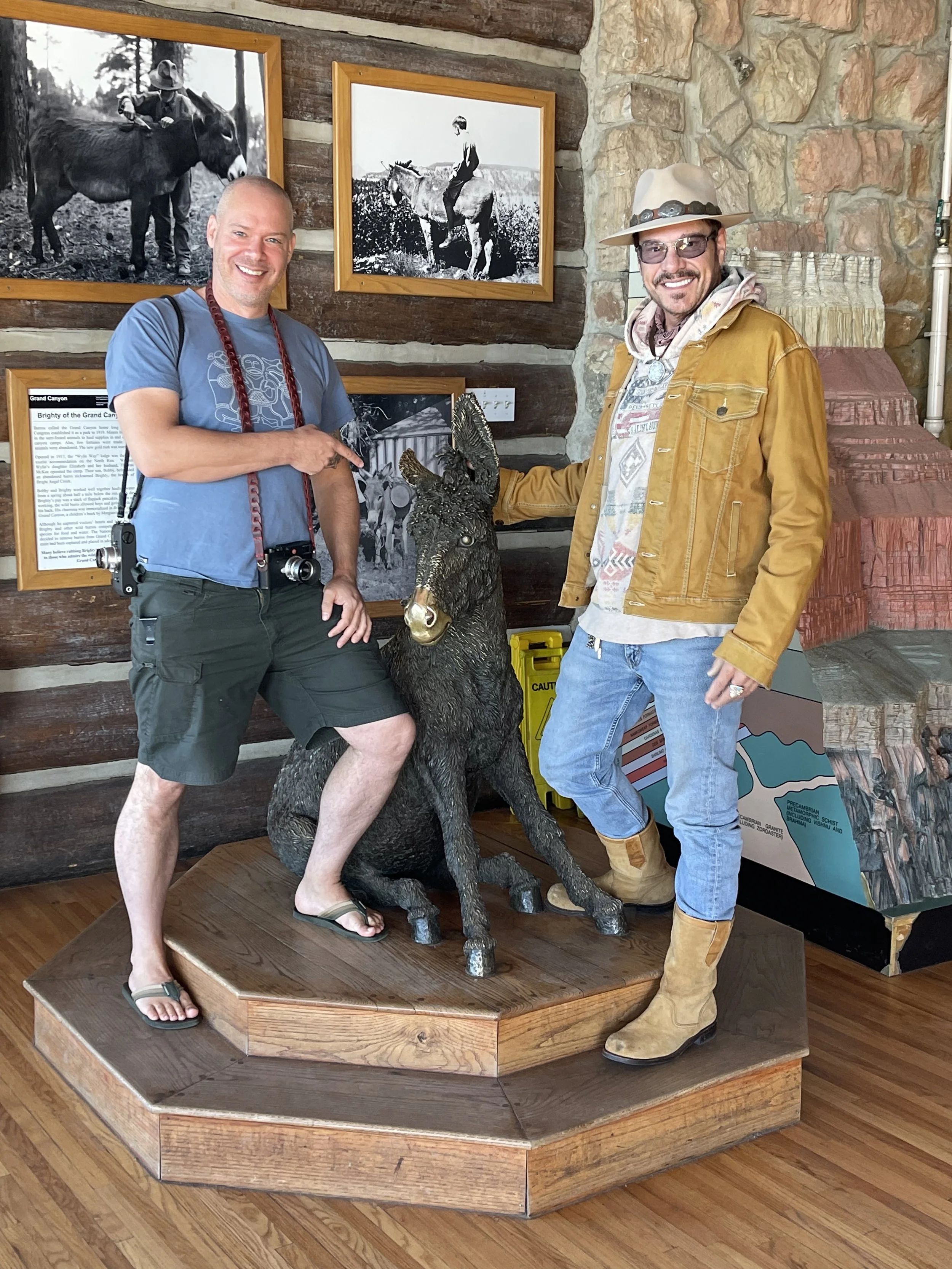
Craig and I at the Grand Canyon North Rim Lodge on our way to Montana. We stopped there overnight for exploration and photographs before continuing north. The historic lodge was destroyed by wildfire in July 2025 and is no longer there.
When you photograph, what are you consciously controlling first: light direction, tonal separation, or subject placement? In other words, what tells you that an image is structurally sound before it becomes expressive?
For me it’s always light direction first. If the direction isn’t clear, nothing else really works. You can have a great face or a great location, but if the quality of the light doesn’t describe the form properly, it falls apart. Once the key direction is right, then I start thinking about separation — how the subject sits against the background.
Has working on professionally lit film sets altered how you think about photographic lighting when you are the one authoring it?
When you spend years walking onto sets where lighting has been thought through hours before you arrive, you understand that what looks simple is usually the most engineered. I used to think in terms of effect — what looks dramatic, and what looks moody. Eventually I realised that it’s not about drama for its own sake, and it’s about coherence in the visual story.
You learn that the key has a reason to exist, and it comes from somewhere believable inside the world of the story. Then everything else supports that — negative space, separation, background shadow density. When that’s all done properly, it doesn’t call attention to itself and it just feels right.
So when I’m photographing, I try to decide early: where is my source? Is it high? Is it lateral? What is it shaping? Once that’s fixed, I build around it and leave it alone. That comes from being inside sets where repeatability matters. If you’re shooting a scene over two days, the light has to match.
It also makes you more patient. You don’t chase expression before the architecture is there. You build the environment first and then the person steps into it. That order matters.
On a well-run film set, lighting is not improvised. It is fixed, repeatable, and designed in advance even if the light is moving through a scene. As a performer, how quickly do you recognise when a lighting environment is coherent and intentional?
You know it immediately. You walk onto a set and you can feel if it’s coherent. If the key is coming from one place and everything supports that, you relax. As an actor I’m sensitive to it because my face, posture and movement is the instrument.
When the lighting is disciplined, you don’t have to push because you can work smoothly with it. The frame is already carrying weight, and that supports the lighting and performance working together.
When lighting is motivated and disciplined, does it change how much you need to “perform”, versus simply work within the frame?
On A River Runs Through It, what I remember most was restraint. Philippe Rousselot wasn’t flooding everything. There was a lot of back separation, a lot of gentle shaping, but it never felt flashy. The interiors especially had this careful, shaped quality — you always knew where the source was meant to be. It was controlled, even when it looked effortless.
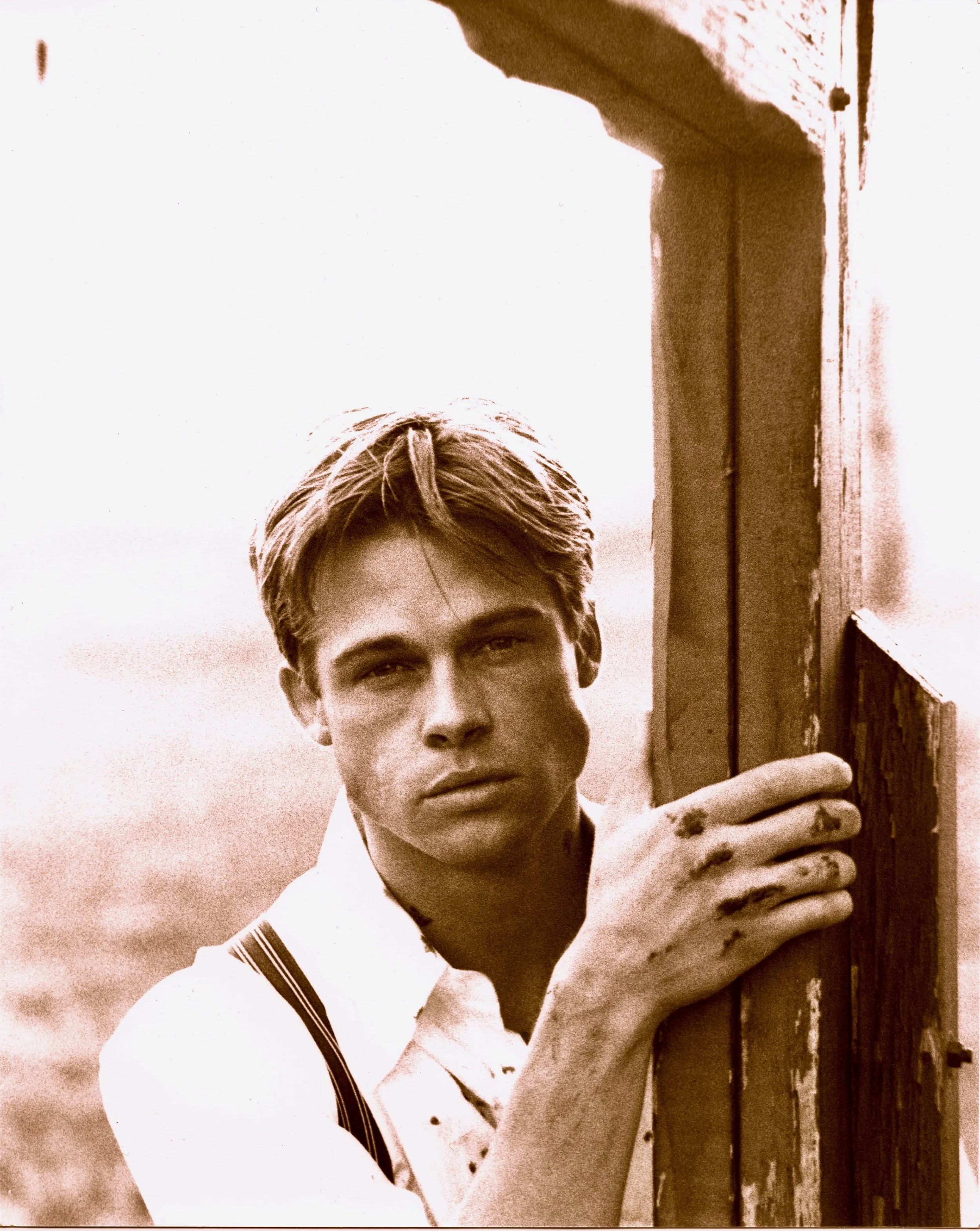
Brad Pitt during the filming of A River Runs Through It, photographed behind the scenes by Craig Sheffer in Montana.
A River Runs Through It is frequently cited for its visual restraint and lighting discipline. From inside the production, what do you remember about how lighting was treated on set?
What stands out to me about that film is that nothing felt rushed visually. Philippe Rousselot was very intentional, but it never felt heavy-handed. The light had direction, and I always understood where it was coming from, even if it was subtle.
Faces had shape. You’d have gentle falloff, controlled contrast, and very careful separation from the background. It wasn’t about flooding everything. There was restraint, and that restraint is what gives the film its tone.
Even the exterior sequences — especially the river scenes — it wasn’t just “stand there and let’s see what happens.” There was blocking that supported the light.
You can feel when the cinematographer and director are protecting the image. You’re not wondering whether half your face is drifting into something unintended and you can trust the frame.
I think that’s why the Academy Award for cinematography made sense. It wasn’t flashy lighting. It was controlled lighting, and it was consistent. It held the emotional tone of the film from beginning to end.
What I take away is that how something is lit is the most important part of the technical process. Although it’s technical, it’s an art in itself that feeds into the artistic process of the actors.
Working under Philippe Rousselot’s cinematography, did you experience lighting as something imposed on performance, or something that performance was built to sit within?
It didn’t feel imposed. It felt like we were placed inside something that was already built. The blocking was designed to sit within that architecture. Robert Redford runs a disciplined set, and Philippe’s lighting was the same way. You weren’t fighting it. You were stepping into something coherent.
When a film’s cinematography later receives formal recognition, such as an Academy Award, does that align with what performers felt on set in terms of clarity, consistency, and trust in the lighting design?
When that film won the Academy Award for cinematography, it made sense. On set, there was clarity and I trusted the image. You knew the frame was going to hold. That kind of confidence trickles down to performance and I don’t feel like I’m guessing.
How does excessive fill, inconsistent key placement, or uncontrolled spill affect your ability to remain grounded and present in front of the camera?
Excessive fill flattens you and removes the architecture of the face. If the spill isn’t controlled, you lose separation, and then you’re just kind of floating there. It makes it harder to stay grounded because the frame has no gravity, and you feel it. Flags are as important lights.
I avoid over-lighting. When everything is equally visible, nothing feels dimensional. Stories need dimension, and taking light away is as important as where it falls on the subject or in the scene.
High-contrast lighting requires precision from both camera and subject, like the scene of Marlon Brando in Apocalypse Now as he moves through deep shadows and light. How does that influence how you hold your face, eyes, and body within the frame?
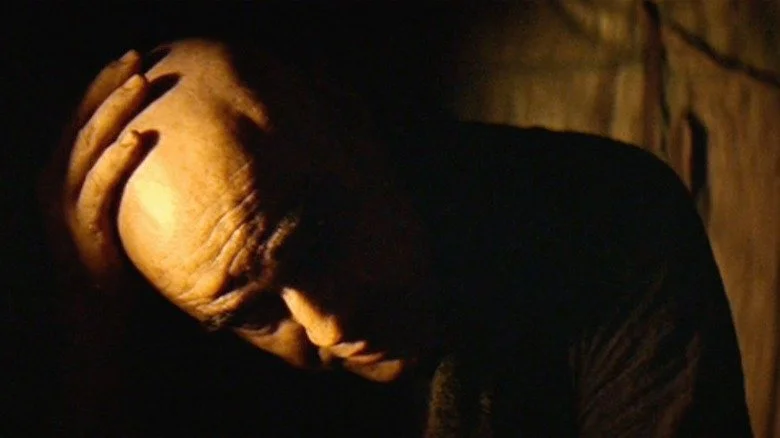
Marlon Brando in Apocalypse Now, lit with strong directional key and deep shadow, a defining example of high-contrast cinematic lighting shaping performance.
High contrast wakes you up straight away. When there’s a strong key and a real shadow side, you feel it. You can’t just move however you want because a small turn of your head changes the whole shape of your face.
If the shadow is deep and you lean too far into it, you lose the eyes. If you turn too far toward the key, the structure flattens out. So you start paying attention to where the light actually sits on you — where the catchlight is, where the cheekbone holds, where the jaw line reads. Once you find that, you work from there.
It naturally makes you more contained. You’re not moving for the sake of moving, every shift has an effect, so you let the light support you.
There’s a feeling to it as well and high contrast has weight and it changes how you carry yourself. Your posture tightens a little, your focus sharpens, and you become more aware of your position in the frame.
At first it can feel strict, but after a while it feels solid. Once you understand where the edge of the light is, you can settle into that space and let the performance happen inside it.
Do you consciously “find” the light when it is well placed, or does that become instinctive once the lighting architecture is stable?
At first you find it consciously. You check where the edge is, where the catchlight is. After a while, if the lighting is stable, it becomes instinct. You just feel where you belong in the space.
In your experience, does controlled light allow for more subtle expression than evenly filled or diffuse lighting?
Definitely. Controlled light allows subtlety. If everything is evenly filled, small expressions don’t register the same way. When there’s structure, the smallest shift in the eyes can change the entire frame.
When you encounter photographers who work with structured, directional lighting rather than reactive setups, does that feel closer to a film set environment?
Yes, that feels much closer to a film set. When a photographer has built a lighting structure and keeps it consistent, it feels professional. You’re not waiting around while someone experiments. You step into a designed environment.
From a performer’s perspective, what creates trust during a portrait session: constant lighting changes, or a fixed lighting structure with clear direction?
Trust comes from stability. If the lighting keeps changing every few frames, you never settle. If it’s fixed, you can relax and focus on presence instead of wondering what’s happening technically.
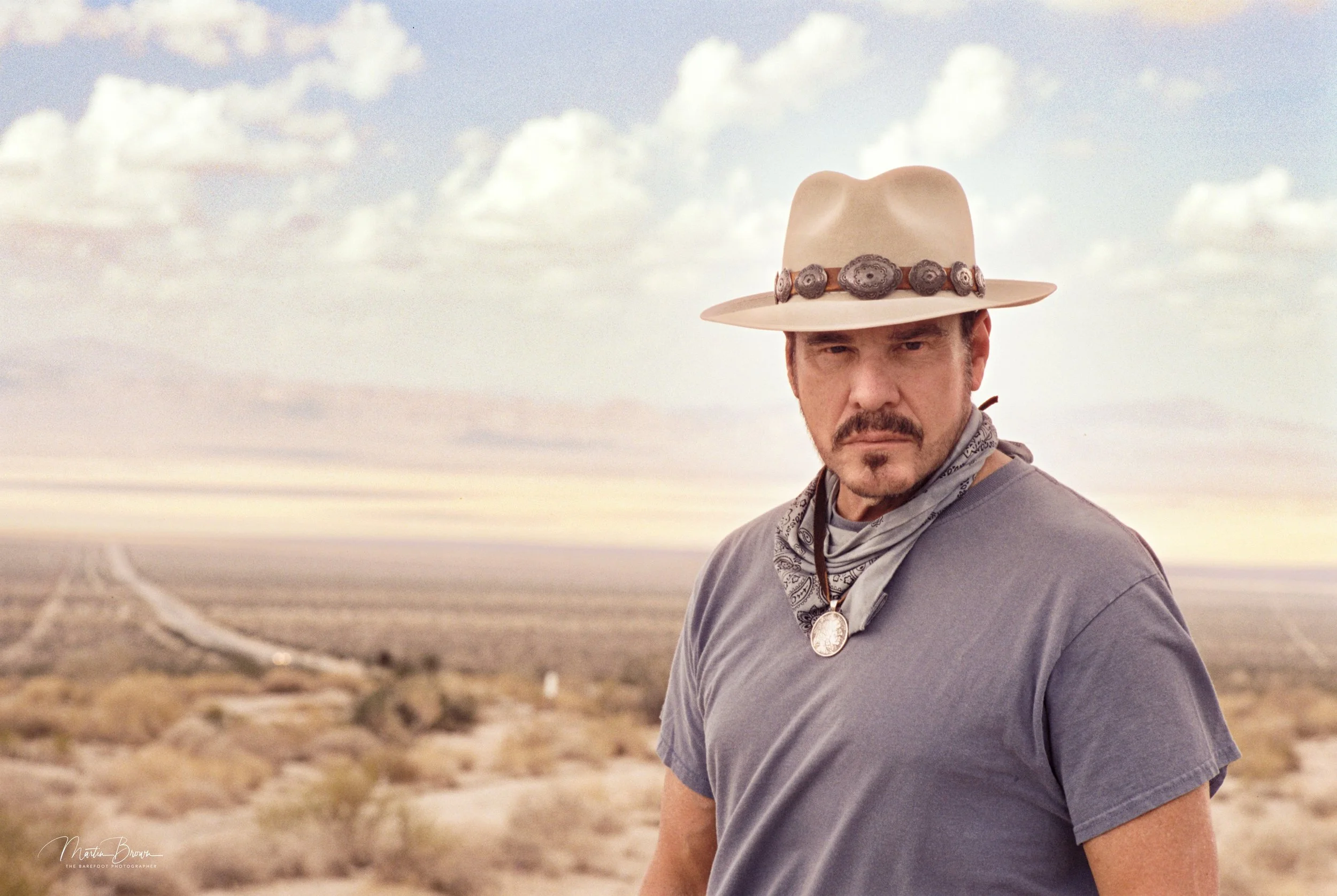
Craig Sheffer in the Mojave Desert, photographed by Martin Brown with a fixed, directional light approach that allowed him to settle naturally into the frame.
What advice would you give photographers who want their subjects to inhabit light rather than pose for it?
I’d say build the light first. Know what it’s doing. Then let the subject move within it. Don’t chase every expression with adjustments. Give them a stable space to inhabit. That’s when real moments happen.
Good lighting, from my point of view, is light that tells you exactly where you belong and lets you live there without thinking about it.
When you’re choosing a lab to develop your film, what are you looking for?
For me it’s consistency first. I want to know that if I expose something carefully, it’s going to come back the way I intended. I’m not looking for interpretation. I’m not looking for someone to “improve” it. I just want it handled properly.
I pay attention to how clean the negatives are, how steady the densities look across a roll, and whether the scans feel honest to what I shot. If I’ve worked hard on contrast or held detail in a shadow, I don’t want that flattened out or pushed around. That’s one of the things I appreciate about your lab in the UK.
Communication matters too. If a lab understands film and treats it like something that needs care, you can tell. That’s what I’m after. I want the lab to respect the exposure and let the work speak for itself.
From Cinematic Lighting to the Finished Photograph
What comes through in Craig's answers is an understanding of photography as a sequence of deliberate decisions.
On a film set, lighting establishes the visual environment in which a performance takes place. The direction of a key light, the depth of a shadow and the separation between subject and background all contribute to how an image communicates.
The same principles apply to still photography. Light determines what the film records, while exposure and composition establish the foundation of the photograph.
For me, one of the most interesting aspects of this conversation is the connection Craig makes between the photographer's intentions and the responsibilities of the film lab. His emphasis on consistency, accurate negative densities and scans that respect the original exposure reflects an important principle: film development and digitisation should serve the photograph rather than introduce an interpretation the photographer never intended.
That is a principle we share at Liquid Light Lab. Our work involves professional C-41, ECN-2 and black-and-white film development, together with high-resolution scanning. We work with photographers who approach their images in different ways, from carefully constructed portraits to documentary photography and experimental work with motion-picture film.
The purpose of our processing and scanning is to give those photographers dependable negatives and detailed digital files that provide a sound foundation for their own creative decisions.
Craig's experiences on A River Runs Through It, his approach to photography and his observations about film processing offer a useful reminder that the technical and creative sides of photography cannot be entirely separated.
A photograph begins with decisions about what to record and how to record it. The work that follows should respect those decisions.
Further Reading
Craig and I also documented a photographic journey through the American West, using Leica M5 cameras and 35mm film while revisiting locations associated with A River Runs Through It. Read A Film Photography Road Trip with Craig Sheffer for photographs and memories from that journey.
For photographers looking for professional film processing, Liquid Light Lab offers 35mm and 120 film developing and high-resolution scanning throughout the UK.
By Martin Brown | The Cinematic Notebook, Liquid Light Lab