

Chiaroscuro is one of photography's most enduring approaches to shaping light. Through the deliberate relationship between illumination and shadow, photographers can create depth, reveal form and direct attention without relying on complex lighting arrangements.
Its origins lie in classical painting, but its principles remain fundamental to cinematography and professional portrait photography.
This three-part series explores chiaroscuro through original photographic work, examining how directional light interacts with the subject, how exposure determines the information recorded on film, and how development and scanning influence the reproduction of that information.
At Liquid Light Lab, these relationships are particularly relevant. Our understanding of film processing and high-resolution digitisation is informed by continuing professional photographic practice, where decisions about light, exposure and negative density begin long before the film reaches the lab.
Part I establishes the foundations of directional light and tonal control. Part II and part III develop these principles through practical studio photography and increasingly complex lighting environments.
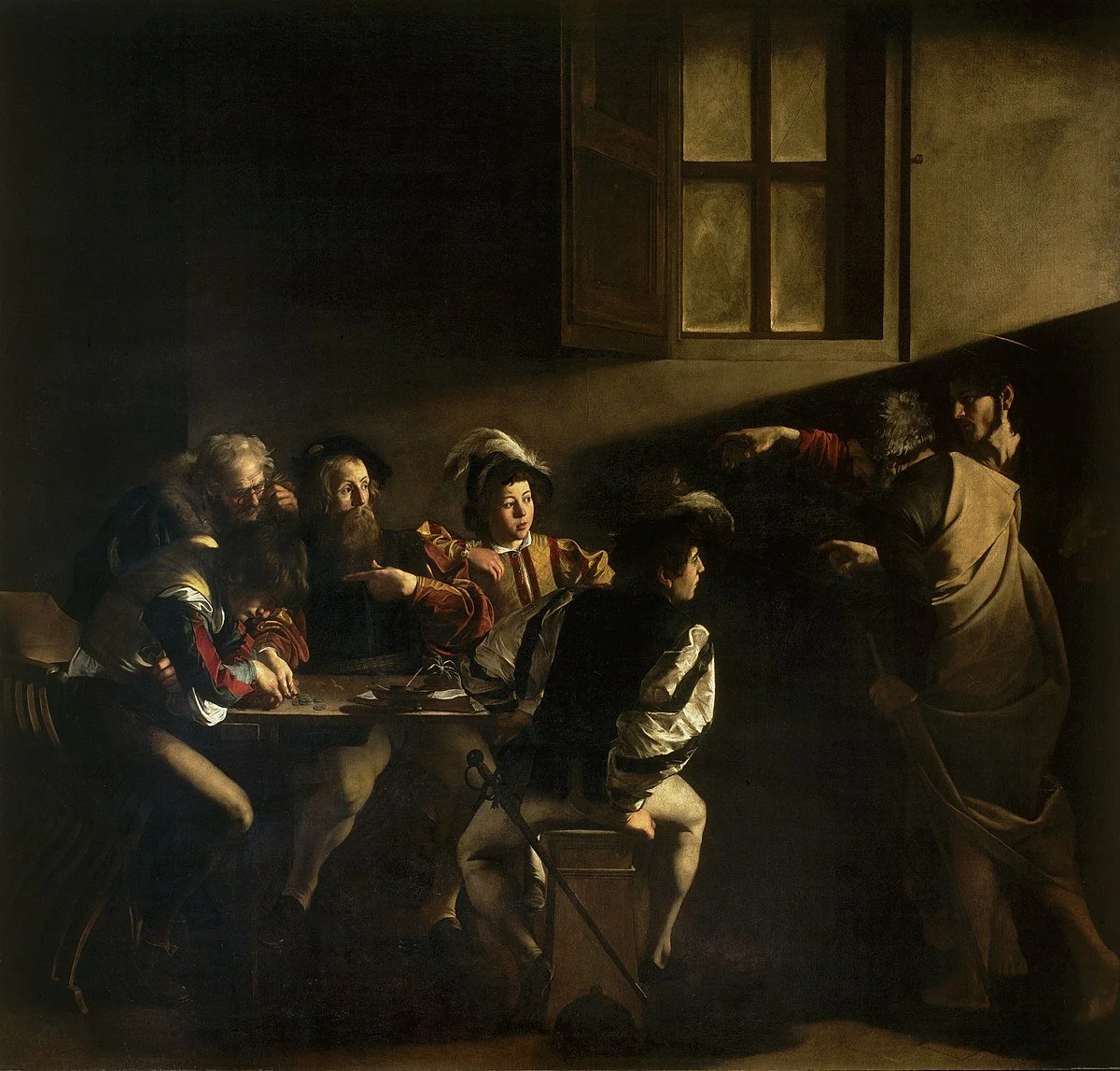
Caravaggio’s The Calling of Saint Matthew — the definitive classical example of chiaroscuro. A single directional source establishes the geometry of the scene, defining form through controlled illumination and shadow. This same structural logic underpins chiaroscuro portraiture on film.
Foundations of Chiaroscuro on Film
Chiaroscuro is the controlled use of directional illumination to create depth, dimensionality, and tonal separation inside a portrait. The term is sometimes used loosely to describe dramatic or shadow-heavy images, but that simplification does not describe its real function. Chiaroscuro is not an effect. It is not an aesthetic layer applied to an image. It is a precise lighting system that defines the physical structure of a portrait through the relationship between illuminated planes and shadow planes.
In its classical origins, chiaroscuro emerged from painters who shaped figures using a single strong source and disciplined falloff. The technique appears in Caravaggio’s directional beams, Rembrandt’s sculptural modelling, and Joseph Wright of Derby’s experimental scenes lit by a single luminous object in darkness. But in the context of photography—especially analogue photography and film making—the technique matters for a different reason: it provides a stable method for shaping form using controlled contrast, predictable geometry, and intentional tonal placement.
How Film Records Directional Light
Photographic film records differences in exposure as changes in negative density.
When directional light strikes a subject, illuminated and shadowed surfaces reflect different quantities of light towards the camera. The film records these differences according to the sensitometric characteristics of its emulsion.
On a developed negative, strongly exposed regions generally produce greater density, while less-exposed regions produce lower density. The relationship is not perfectly linear across the entire exposure range: the characteristic curve describes how the film responds through shadows, midtones and highlights.
For chiaroscuro photography, this matters because the intended tonal separation must first be recorded with sufficient exposure. A shadow may appear almost black in the finished photograph while still containing useful information on the negative. Equally, a shadow that received insufficient exposure may contain little recoverable detail, regardless of subsequent development or scanning. The photographer must decide which parts of the subject require visible information and which can legitimately fall into darkness.
This is where film selection and exposure become important. Different emulsions have different characteristic curves, effective speeds, contrast responses and exposure latitudes. Correct processing preserves the intended development characteristics of the negative. High-quality scanning then allows the recorded tonal relationships to be reproduced and interpreted without unnecessarily sacrificing available information.
The result depends on the complete photographic process, beginning with the placement of light and ending with the reproduction of the negative.
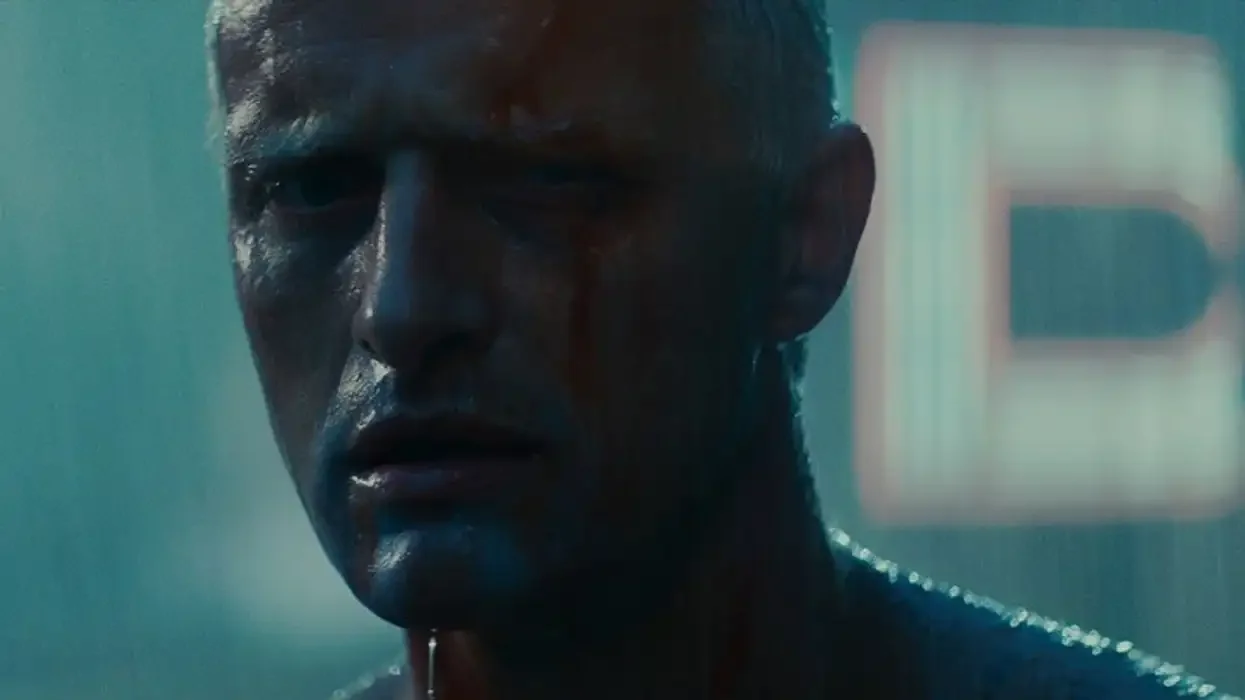
Rutger Hauer as Roy Batty in Blade Runner (1982).
A perfect modern example of chiaroscuro: a motivated key source, sculpted falloff, and controlled shadow density.
This behaviour makes film uniquely suitable for chiaroscuro because the technique relies on predictable relationships between light and shadow. When that relationship is stable in the recording medium, shaping becomes far more reliable.
Why Film Handles Chiaroscuro Better Than Most Modern Photography Practices
The dominant lighting habits in much of contemporary photography favour broad, even illumination. This produces images with weak shadow structure, minimal falloff, and reduced directional logic. Chiaroscuro requires the opposite approach. It depends on:
a single directional source
intentional shadow density
controlled falloff
defined planes
stability in low zones
Film stocks such as Rollei RPX 100, RPX 400 and the Kodak Vision3 cinema stocks have the latitude and tonal stability to hold detail deep into these zones. Shadows that appear heavy or deep in the final scan remain structured and textural on the negative. The depth is intentional, not a failure of exposure.
Film’s physical response curve makes these decisions predictable. Once light shapes the subject, the negative records that structure as density, not interpretation. The relationship between highlight, midtone and shadow becomes fixed and coherent.
This is why chiaroscuro works so effectively on film: it uses the medium’s natural strengths—stable shadows, smooth rolloff, and reliable midtone behaviour—rather than fighting against them.
Directional Illumination as Geometry
The core of chiaroscuro is geometry. Every portrait is shaped by the angle, distance, height and behaviour of a single motivated light source. That source determines:
the path of illumination
the location and density of shadows
the clarity of transitions
the viewer’s perception of three-dimensional depth
A high, angled source strengthens the brow ridge and jawline. A lateral source emphasises cheekbones and nasal shape. A lower source reduces vertical structure and creates a flatter, more compressed appearance. These effects are not interpretive. They are mechanical outcomes of light direction.
Once a directional choice is made, the lighting system becomes a closed set. Every adjustment must reinforce the original architectural decision. Strengthening the source, modifying its spread, adding or removing fill, flagging spill—all must support the primary direction. In chiaroscuro, inconsistency is visible instantly. A second unmotivated light destroys the shape. Spill contamination reduces depth. Reflected light from walls, ceilings or clothing can weaken transitions.
This is why chiaroscuro is seen as a disciplined method: it requires the photographer to build structure step by step, not improvise it.
Shadow as Structure, Not Absence
The shadow plane is not a by-product of the key light. It is an active component of the portrait. A shadow that is placed intentionally reveals the same structure as the illuminated side—it simply describes that structure with absence rather than presence. In chiaroscuro:
shadows carry information
shadows shape depth
shadows define edges
shadows balance the composition
shadows provide visual silence
Film supports this behaviour. A deep shadow in a final scan may look almost black, but the negative contains texture and tone where sufficient exposure has recorded it. This allows you to sculpt the subject with confidence: the shadow plane will remain textural as long as exposure is placed with intent.
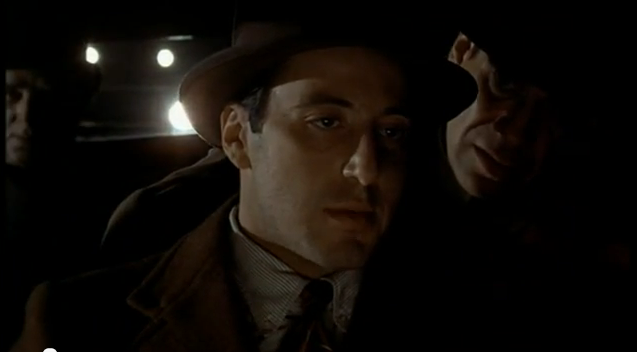
Chiaroscuro used as narrative structure: a single motivated source shapes Michael Corleone’s face while the surrounding figures fall into controlled shadow. The frame shows how directional light, falloff and selective visibility build presence and depth—exactly the same principles applied in portraiture on film.
Reflectors, negative fill, flags, cutters, barn doors and modifiers are used to control the shadow plane, not eliminate it. A reflector adds controlled lift without flattening contrast. Negative fill deepens the shadows and increases lighting contrast. Flags remove spill and maintain directionality. These shaping tools ensure that the lighting remains coherent.
How Lens Design Influences the Recorded Image
Directional light establishes the physical relationship between illuminated and shadowed surfaces. The lens determines how that information is projected onto the film.
Different optical designs can influence contrast transmission, flare, resolution, aberrations and the rendering of areas outside the plane of focus. These characteristics can become especially noticeable in photographs with strong differences between light and shadow. An early uncoated Zeiss Sonnar, for example, can exhibit different flare and contrast behaviour from a later multicoated lens. Those optical differences may influence the apparent separation between illuminated surfaces and darker areas of the image.
The lens captures the lighting ratio across the subject, established by the light sources, their placement, the surrounding environment and the subject's position.
Lighting creates the physical structure of chiaroscuro. The lens influences how that structure is recorded. For photographers working with older lenses, understanding flare and contrast behaviour can be particularly useful when photographing strong directional light or bright sources against dark surroundings. Combined with film choice and exposure, these characteristics contribute to the visual qualities of the finished negative.
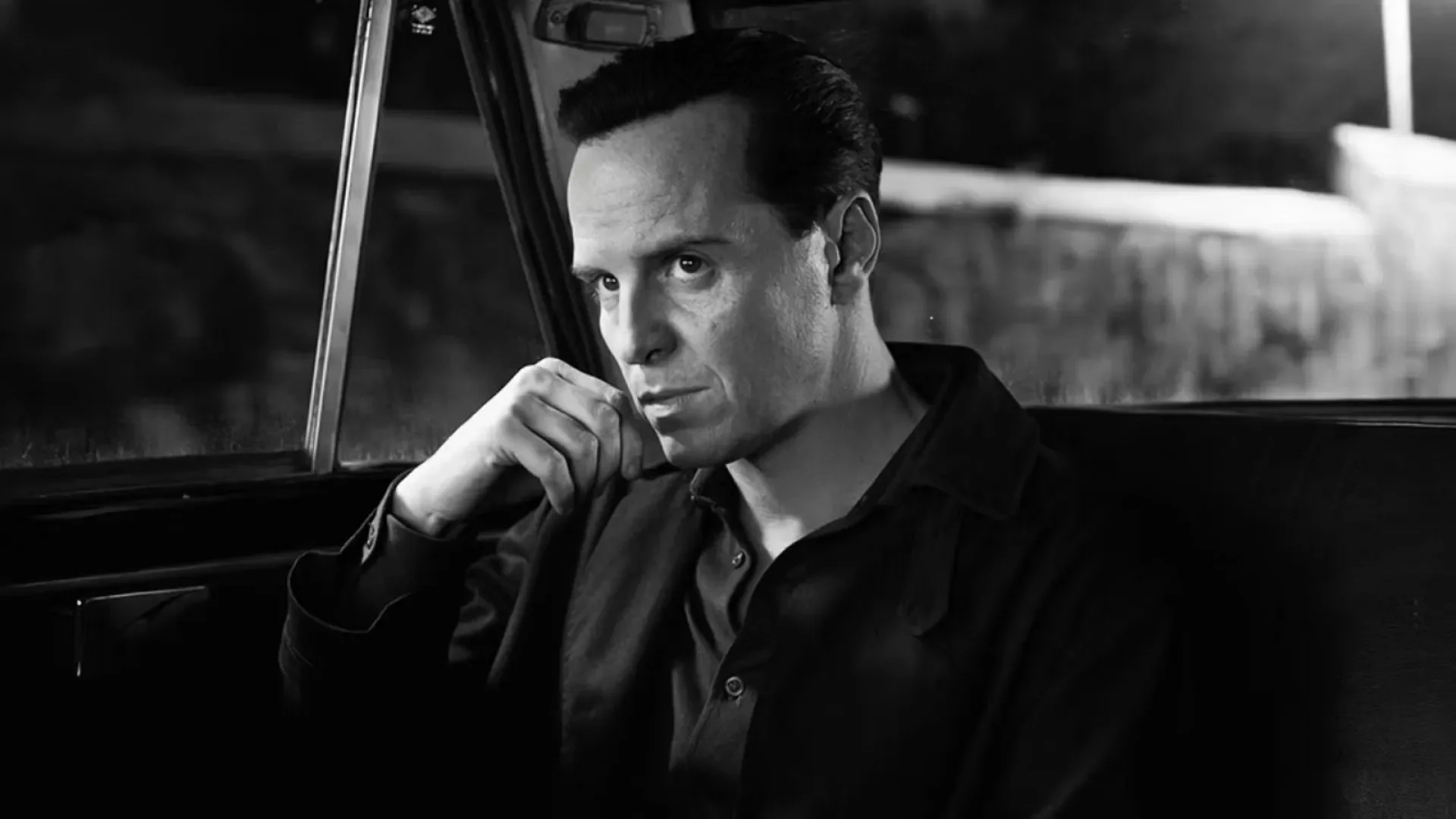
Andrew Scott in Ripley (2024). The series was shot on vintage, uncorrected spherical lenses that were rehoused for modern digital Arri cinema cameras. These older optical designs were chosen for their tactile micro-contrast, textured rolloff and disciplined chiaroscuro response, echoing the rendering characteristics of early Sonnar designs used in analogue portraiture. If I didn’t know it was shot on digital, I’d think it may be panchromatic film using a 1930’s Zeiss Sonnar lens, with a red filter.
These lenses form a technical bridge between analogue portraiture and motion-picture lighting systems. The rendering qualities that directors of photography seek for controlled contrast, expressive midtones and sculpted falloff are the same qualities your own workflow can use to support analogue chiaroscuro.
Always bear in mind: the camera body plays no role in this behaviour. Only the film, the lens, and the light shape the result. Look to lens systems first, and then work backwards to camera bodies. From there you will be in the right position to create the images that you see in your minds eye.
Building a Chiaroscuro Portrait: A Mechanical Process
Chiaroscuro is practical. It works on location, in a studio, in constrained indoor settings, or in improvised environments. The process is mechanical:
Determine source direction
High, lateral, or low depending on the desired structure.Place exposure for shadow density
Film latitude makes this predictable.Shape transitions
Adjust distance, modifier, falloff.Control the environment
Remove unwanted reflections.Reinforce the single-source logic
Do not add unmotivated light.Orient the subject
Face angle must match the directional design.
When the method is executed with discipline, the portrait gains architectural clarity. Depth becomes structured. Planes read correctly. The viewer interprets the image as cinematic not because it imitates a style, but because the lighting system is the same system used in film production and classical studio portraiture.
Film Response: Why Chiaroscuro and Celluloid Align
Chiaroscuro emerged in classical painting, but the technique became fully realised in cinema. Directors of photography such as James Wong Howe, Vittorio Storaro, Stanley Cortez and John Alton developed lighting systems built on motivated single-source illumination, disciplined falloff and strict spill control. Film rewarded this approach because its tonal structure relied on controlled highlights, rich shadow detail and stable midtones. These characteristics allowed chiaroscuro to become a longstanding cinematic standard.
The same principles apply in analogue portraiture today. Film responds predictably to directional light, recording the shape of illumination as physical density on the negative. When the lighting structure is intentional, the cinematic quality arises from function rather than stylistic imitation.
Chiaroscuro in Practice: Photographing Simon Bamford
The portrait below of Hellraiser actor Simon Bamford provides a practical example of directional light establishing shape and depth.
A dominant key light illuminates one side of the face, while reflected light from the opposite wall provides a restrained degree of illumination on the shadow side. The reflected light is important. Without changing the primary direction of illumination, it allows selected facial features to remain visible while preserving the contrast that gives the portrait its structure.
This demonstrates an essential principle of chiaroscuro: shadow does not have to mean a complete absence of information. Instead, the photographer chooses how much of the subject should remain visible and uses the lighting environment to establish that relationship before making the exposure.
Photographed on film by the Liquid Light Lab team, developed and scanned at Liquid Light Lab, the portrait connects the practical decisions made during the session with the technical process of reproducing the finished negative.

A portrait of Hellraiser actor Simon Bamford, photographed on film using a single motivated key and natural wall bounce to shape the shadow plane. This approach—precise directional light, controlled falloff and readable density—follows the same chiaroscuro principles used in mid-century cinema and classical painting. The result is a structured, cinematic rendering built from light discipline rather than post-production.
This example demonstrates how analogue film, combined with intentional lighting design, produces the depth, dimensionality and tonal discipline associated with chiaroscuro across both portrait photography and classical cinema.
Where This Series Continues
This article forms the foundation of a larger series on directional light, tonal structure and controlled contrast on film. The next parts will move from principle to application: how shadow architecture is built, how modifiers define the geometry of a portrait, how metering decisions shape the negative, and how cinematic lighting systems from historical film production translate directly into contemporary still photography. Each section will expand the practical framework, building toward a complete, structurally coherent method for lighting portraits on film with precision and intent.
Part 2: Directional Light on Film: Building the Chiaroscuro Portrait (Part II)
Part 3: Chiaroscuro, Part III: Control, Containment, and the Discipline of Light (Part III)
By Martin Brown | Liquid Light Whisperer
The portrait of Simon Bamford shown in this article was developed and scanned in-house at Liquid Light Lab, the studio’s UK-wide 35 mm processing and scanning service based in Leamington Spa. The Lab handles ECN-2, C-41 and black-and-white workflows, including pyrogallol development for high-precision tonal control.