

I recently did a professional studio session produced in collaboration with Candido Collective, with Nadia Dutchak modelling and hair and make-up by Iryna Pasechnik. The objective was to demonstrate how motion picture film behaves when exposure index, lighting structure, development chemistry and scanning are treated as one continuous workflow.
All colour film was supplied by Candido and processed in ECN-2 chemistry at Liquid Light Lab. The black and white images were shot on Rollei RPX 400. The session was structured deliberately from the first lighting decision through to final scan, and every stage was handled with the understanding that film rewards precision if every step of the workflow is followed.
The final image is not constructed in post-production. The tonal structure begins at exposure, is fixed in the negative through development, and is preserved in the scan. Grading is the final stage of that process, not a correction of it. It refines highlight roll-off, midtone separation and colour balance that already exist within the negative.
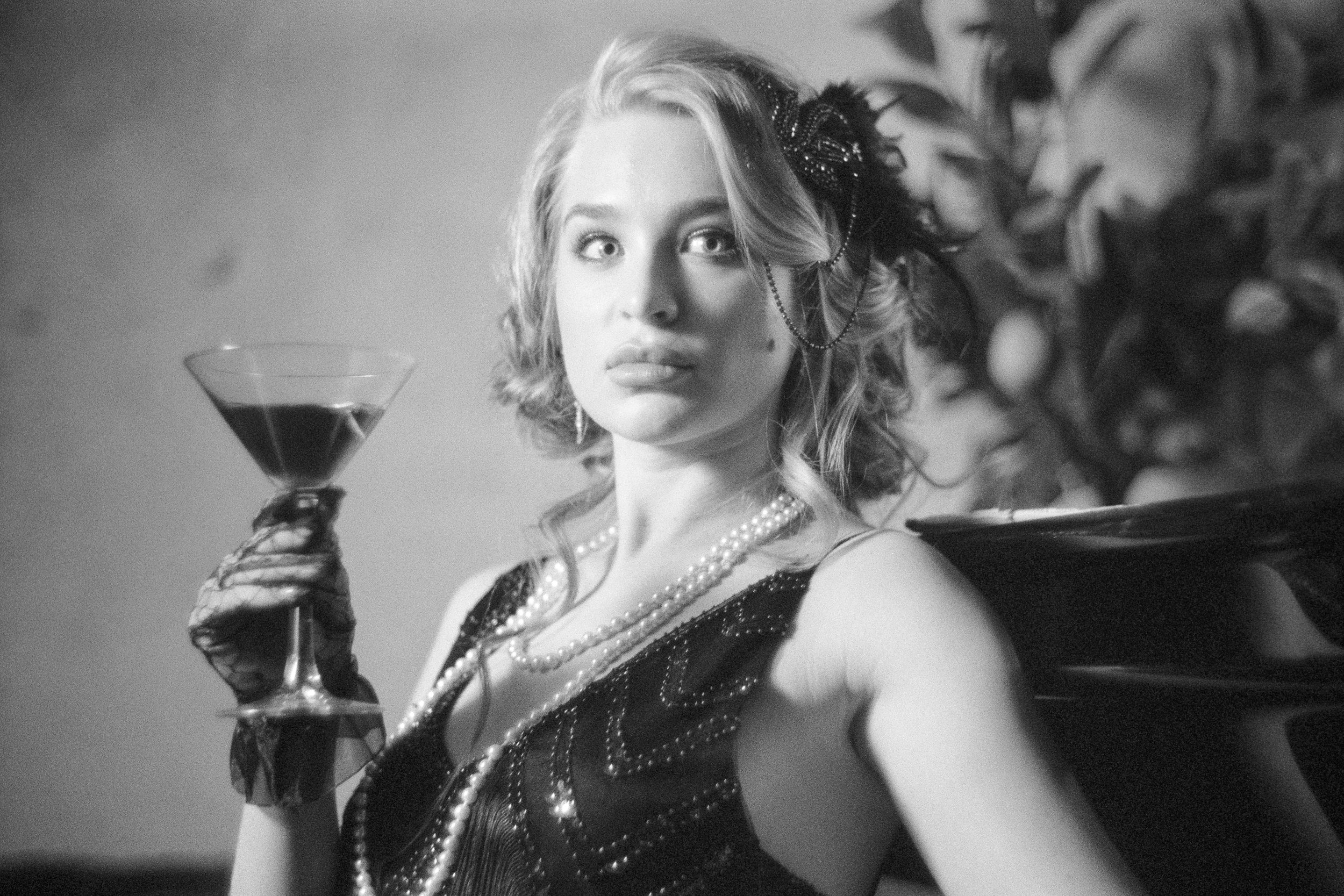
Rollei RPX 400 shot at EI 400 to demonstrate the structured noir lighting, with the bare-bulb key softened through a scrim to shape highlight transitions.
That distinction matters, particularly with Kodak Vision3-derived film such as Candido 400. Vision3 is not engineered primarily for optical printing in the traditional darkroom sense; it is designed from the ground up for digital intermediate workflows. In motion picture production, the negative is scanned at high bit depth and graded digitally. The film is optimised to retain highlight latitude, smooth roll-off and extensive tonal information specifically so that it can withstand scanning and colour grading without breaking apart.

Candido 400 exposed to increase negative density, processed in ECN-2 chemistry and scanned without tonal compression before grading.
When still photographers treat Vision3 as if it were conventional C-41 print film, they often miss this fundamental design philosophy. The emulsion holds far more highlight detail than a standard print-oriented negative, but only if that density is preserved in exposure and maintained through development and scanning. If the scan compresses the top end early, or if the development alters the intended curve, the advantage built into the film is lost.
In this session, exposure index was chosen to increase negative density intentionally. That density was not reduced or manipulated in development. The ECN-2 process preserved the native curve and highlight latitude of the emulsion. The scan was performed in a way that retained the full tonal range before grading was introduced. As a result, the grading stage refined colour and contrast without manufacturing structure that was not already present.
Vision3’s strength lies in its ability to carry subtle highlight information and smooth transitions through to a digital grade. When handled correctly, it behaves exactly as it was designed to: a capture medium that anticipates scanning, not a print medium that requires reinterpretation. The final images reflect that continuity. They are the product of exposure, chemistry and scan discipline working in alignment, rather than software attempting to compensate for lost information.
Exposure Index as a Creative Control
Candido 400 is derived from Kodak VISION3 250D, a daylight-balanced motion-picture negative film. For this session, I rated it at EI 200, providing one additional stop of exposure relative to Candido's advertised ISO 400, or approximately one-third of a stop relative to the underlying Kodak 250D emulsion.
This was a deliberate exposure decision. The additional light increases negative density, particularly in the shadow regions, allowing more information to be recorded in the darker values while taking advantage of the emulsion's extended highlight latitude. The intention was to establish a negative with substantial tonal information that could be carried through ECN-2 development and high-resolution scanning.
Development was kept normal in ECN-2. There was no push, and there was no compensation to counter the exposure decision. The intention was to allow the film’s native curve to remain intact while benefiting from the increased density created in camera. The result is a colour negative that scans with generous highlight latitude and a gently moderated colour intensity. The slightly pastel quality in the graded images is not a stylistic overlay; it is the natural outcome of controlled overexposure combined with stable development.
The black and white work followed a different logic, and it’s here to show pure lighting structure without colour affecting perception. I rated Rollei RPX 400 at box speed.
Exposure index, when understood properly, determines how much information survives into development and scanning. It is the first structural decision in the chain.
Constructing the Light
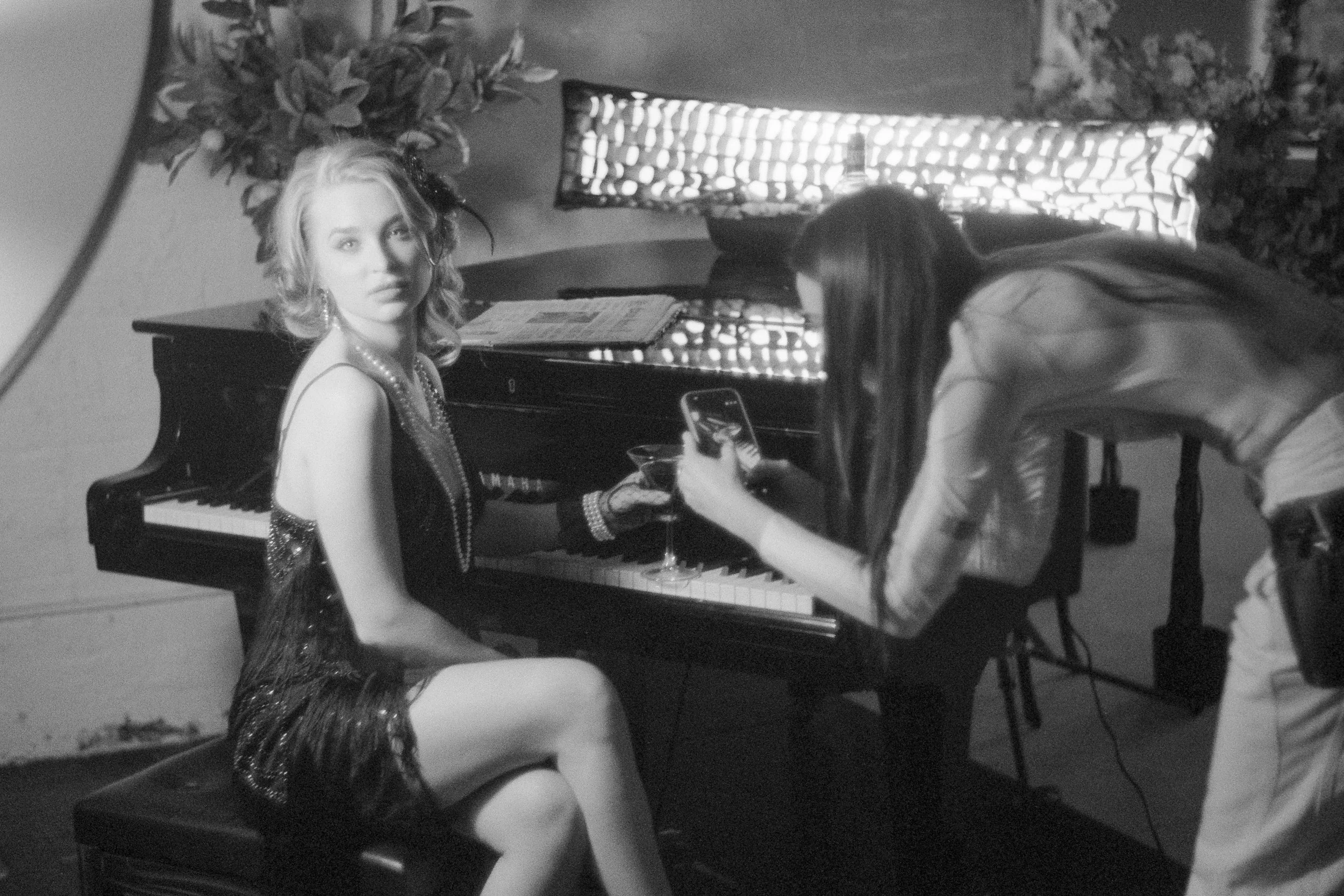
Quick continuity check at the piano while Nadia holds position, with the horizontal gridded strip already set behind for controlled edge and depth in the lighting.
The lighting build was deliberate and hands-on. The primary key light was a bare bulb fitted with barn doors to control spill precisely. A scrim was placed in front of the bulb to soften the output while preserving directionality, creating smooth highlight transitions without flattening facial structure.
To the right of the subject, a strip light fitted with a grid was positioned to shape the shadow side. The grid ensured that fill remained contained and did not wash across the background or dissolve the negative space that gives noir lighting its depth. Its role was subtle but essential, refining separation without eliminating contrast. In a twist to normal use the strip box was placed horizontally, not vertically.
Two assistants worked continuously under direction, adjusting barn doors, repositioning the scrim, and fine-tuning the strip’s angle as Nadia moved within the set. The lighting was not static. It was adjusted in response to how density gathered across cheekbones, shoulder lines and fabric texture.
Hair and make-up were designed specifically to respond to side light. Iryna’s work emphasised definition and surface quality so that the lighting would articulate shape rather than overpower it. Nadia engaged with the light rather than posing independently of it, allowing the tonal pattern to guide movement and expression.
The atmosphere in the studio was focused but fluid, with every adjustment measured against the negative’s response rather than the rear screen alone.
Optics and Rendering

My Leica M3 was paired with the Voigtländer 50mm f/1.1. The large rangefinder magnification of the M3 makes precise focusing possible even wide open at f/1.1, which keeps the pace of the session fluid and allows the model to remain in rhythm rather than waiting on technical adjustments.
The lenses used were a 1939 Sonnar 50mm f/1.5 and a Voigtländer 50mm f/1.1. These lenses shape micro-contrast and highlight behaviour in distinct ways. The Sonnar produces smooth tonal transitions that complement structured side lighting, while the Voigtländer introduces a different balance between clarity and glow.
Optical rendering influences far more than simple sharpness. It determines how highlights bloom, how contrast transitions behave, how edges resolve, and how the image breathes under structured light. When combined with deliberate exposure index decisions, the lens becomes an active participant in shaping tonal direction rather than a neutral conduit between subject and film.
How a lens draws is paramount to the final look of an image because film does not record scenes in isolation; it records the interpretation delivered by the optics. A lens with strong micro-contrast will emphasise separation between adjacent tonal values, giving shadow edges a firmer structure and midtones more articulation. A lens with smoother transition characteristics will allow highlights to roll gently into surrounding tones, producing a more cohesive and less clinical rendering. These behaviours are optical in origin, not chemical, and they are embedded into the negative before development ever begins.
In structured noir lighting, this becomes critical. Side light exaggerates transitions between illuminated and shadowed planes. A lens that resolves edges abruptly can make that transition feel harsh, while a lens that draws with smoother gradation can maintain depth without brittleness. Highlight bloom at wider apertures also affects perceived latitude. A slight glow around bright areas can soften the boundary between highlight and midtone, supporting smoother roll-off when the film is rated for increased density.
When exposure index is lowered to build density in the shadows, the lens’ drawing style determines how that density is perceived. If the optic maintains strong separation in low-contrast areas, the added exposure translates into visible tonal layering. If the lens flattens micro-contrast, the same density may feel less dimensional. The exposure decision and the optical rendering therefore interact directly.
The 1939 Sonnar and the Voigtländer 50mm f/1.1 used in this session each bring distinct rendering characteristics. The Sonnar’s classic optical formula produces smooth transitions and cohesive midtones that complement directional lighting, while the Voigtländer offers a different balance of clarity and highlight behaviour that changes the character of the same light. Neither lens is interchangeable in effect, even under identical lighting ratios and exposure settings.
Film records what the lens gives it. Development preserves what the film records. Scanning translates what the development reveals. If the lens draws with intention, the entire chain benefits. If it does not, no amount of careful processing can introduce a rendering quality that was never present in the first place.
ECN-2 Film Development: Preserving the Motion-Picture Negative
All Candido colour film from this session was developed in ECN-2 chemistry at Liquid Light Lab.
Although Candido's remjet-free construction allows it to be processed in either C-41 or ECN-2, the choice of chemistry has important implications for the resulting negative.
For this project, ECN-2 was selected to retain the tonal characteristics of the underlying motion-picture emulsion, particularly its extended highlight latitude and separation through the tonal scale.
Because the exposure index had been deliberately chosen in the studio, development needed to preserve the density relationships established in camera. Accurate temperature control, appropriate chemical activity and development consistency were fundamental to that objective.
The film was processed normally, without push or pull adjustment. The increased exposure remained an intentional part of the negative, rather than something to be compensated for during processing.
For photographers shooting Candido and compatible remjet-free VISION3-derived films, Liquid Light Lab provides ECN-2 development and high-resolution scanning through our UK mail-in service.
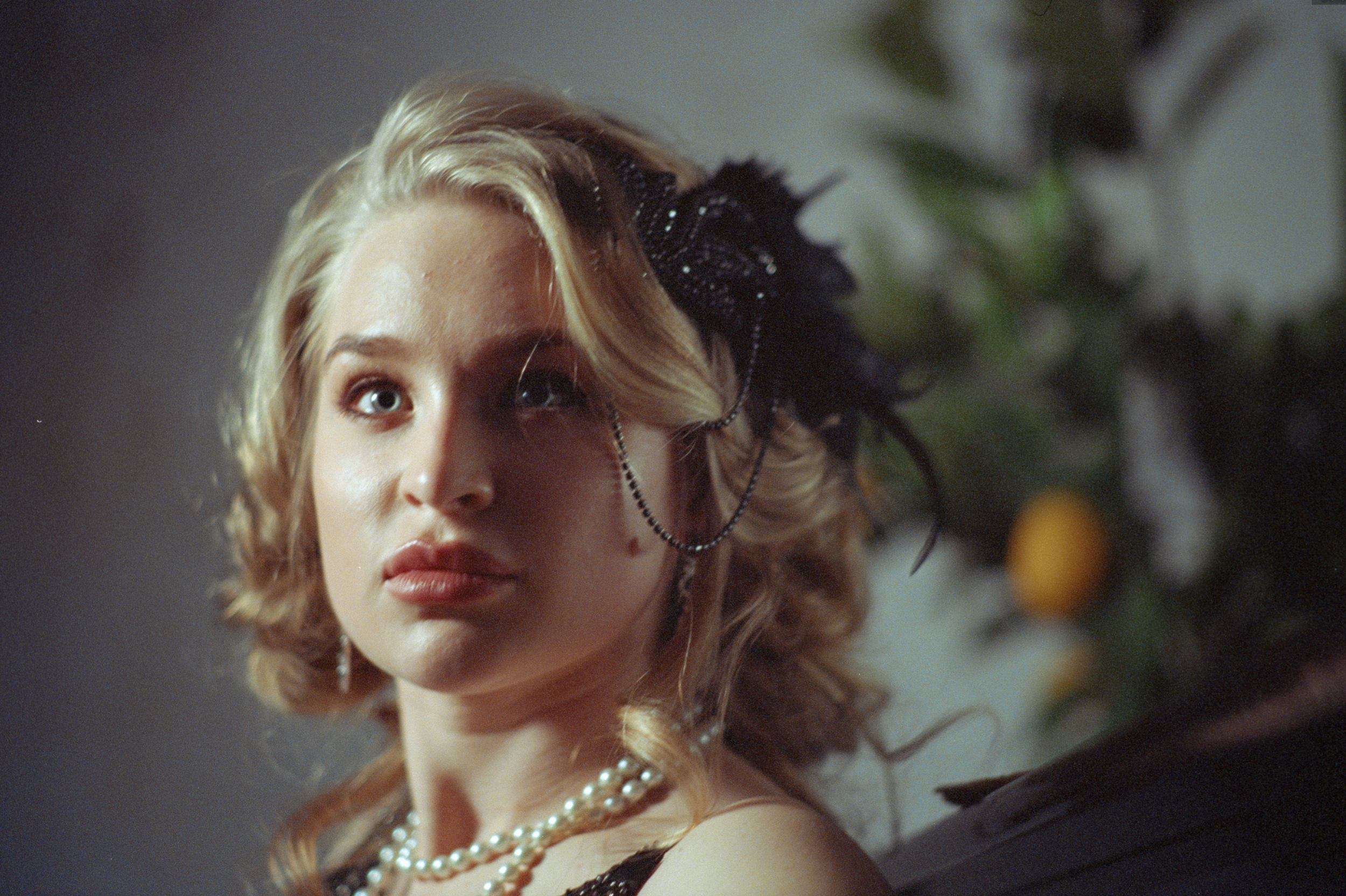
Candido 400 processed in ECN-2 and scanned to preserve full negative latitude. This is the straight scan, with no grading applied.
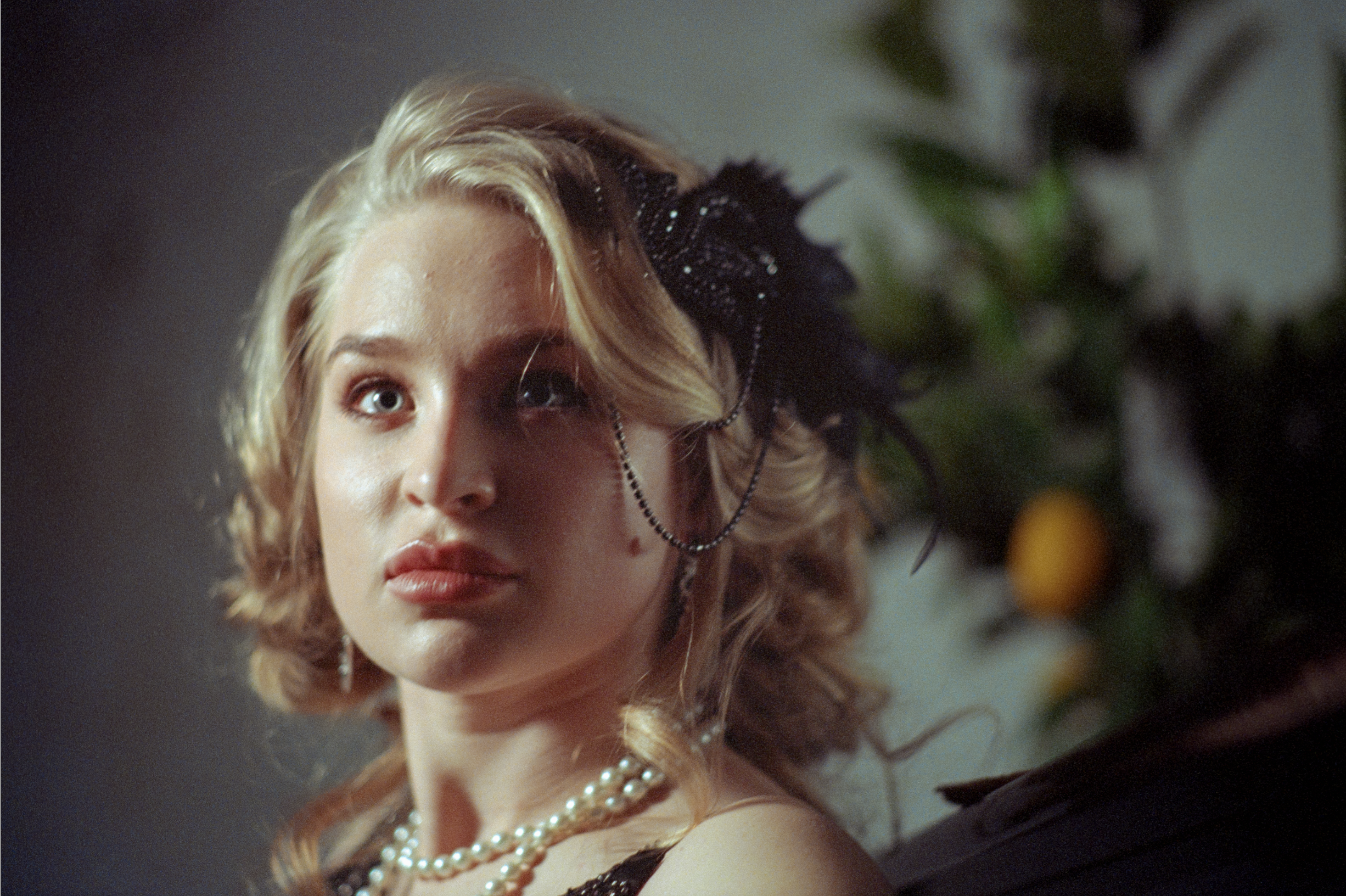
The same frame after colour grading. Density built in camera is shaped rather than corrected, preserving highlight roll-off and tonal separation.
Scanning for Grading Latitude: Why Cinema Negatives Demand More
Kodak VISION3 was engineered to retain an extended range of photographic information, particularly in the highlights. Its characteristic curves allow substantial exposure latitude, making it possible to retain tonal separation across scenes containing bright illumination, delicate midtones and deep shadows. Recording that information on film is only part of the process, and the scanner must have sufficient dynamic range to digitise it.
Traditional automated minilab scanners were designed primarily for high-volume photofinishing rather than the demands of the cinema digital-intermediate workflow. Their CCD capture systems, associated electronics and automated image-processing pipelines impose limitations on how much negative density information can be recorded and preserved.
The problem begins at the sensor.
A CCD has a finite capacity for collecting charge and an electronic noise floor below which small differences in illumination become difficult to distinguish. Dense areas of a colour negative transmit less light, making the recovery of subtle highlight information particularly demanding. Where the sensor and its electronics cannot distinguish those small differences reliably, the information cannot be recovered through subsequent colour grading.
Kodak has documented the problem directly. In its technical paper Scanning Recommendations for Extended Dynamic Range Camera Films, prepared in collaboration with ARRI, Cintel, FilmLight, Digital Film Technology and Lasergraphics, Kodak explains that traditional 10-bit film-scanning encodings can fail to preserve the extended highlight information contained within VISION3 negatives. The paper identifies properly implemented 16-bit scanning as the preferred technical solution, provided the optical and electronic capture system can measure the full density range in the first place.
This distinction is fundamental. Saving a photograph as a 16-bit TIFF does not mean the original capture contained 16 bits of meaningful photographic information. Greater output precision cannot reconstruct tonal differences that the sensor failed to record.
Automated minilab workflows introduce a further limitation. Their colour correction, contrast adjustments and negative interpretation are optimised for efficient photographic output, rather than preserving the full density structure of motion-picture film for subsequent grading. Once information has been clipped or compressed beyond recovery, later adjustments cannot restore the original transitions.

Rollei RPX 400 developed in Pyro chemistry. The proportional stain reinforces highlight separation along the cheekbone and shoulder while holding depth in the shadow side of the face. That extended tonal structure requires high bit-depth scanning to retain the full range; automated mini-lab workflows compress this type of negative too early.
How Liquid Light Lab Approaches Cinema-Negative Scanning
At Liquid Light Lab, our approach is built around capturing the negative's available information before introducing creative colour and contrast decisions. The Liquid Light Chamber combines high-resolution digital capture, precision optics, controlled illumination and a high-bit-depth imaging workflow designed to retain fine detail and subtle tonal relationships.
Our scanning process separates the technical capture from the final interpretation, allowing the information held within the negative to provide the foundation for grading. This is particularly important with ECN-2 processed VISION3-derived films, where the extended highlight latitude and gradual density transitions are essential to the material's photographic characteristics.
The studio images presented here demonstrate that relationship. Candido 400 was deliberately exposed at EI 200, developed normally in ECN-2 chemistry and scanned before final grading. The initial scan retains the tonal information established during exposure and development, while the finished grade shapes its colour and contrast. The creative decisions made in the studio are therefore carried through the processing and scanning workflow rather than being replaced by digital correction.
This approach is also independently recognised by Candido Collective, which identifies Liquid Light Lab as a specialist processing partner for C-41 and ECN-2 development and high-dynamic-range, 16-bit scanning.
For photographers working with motion-picture emulsions, this is not simply a difference in how finished scans look. It is a difference in how much of the negative's recorded information remains available when the final image is created.
Professional Photography at the Heart of Liquid Light Lab
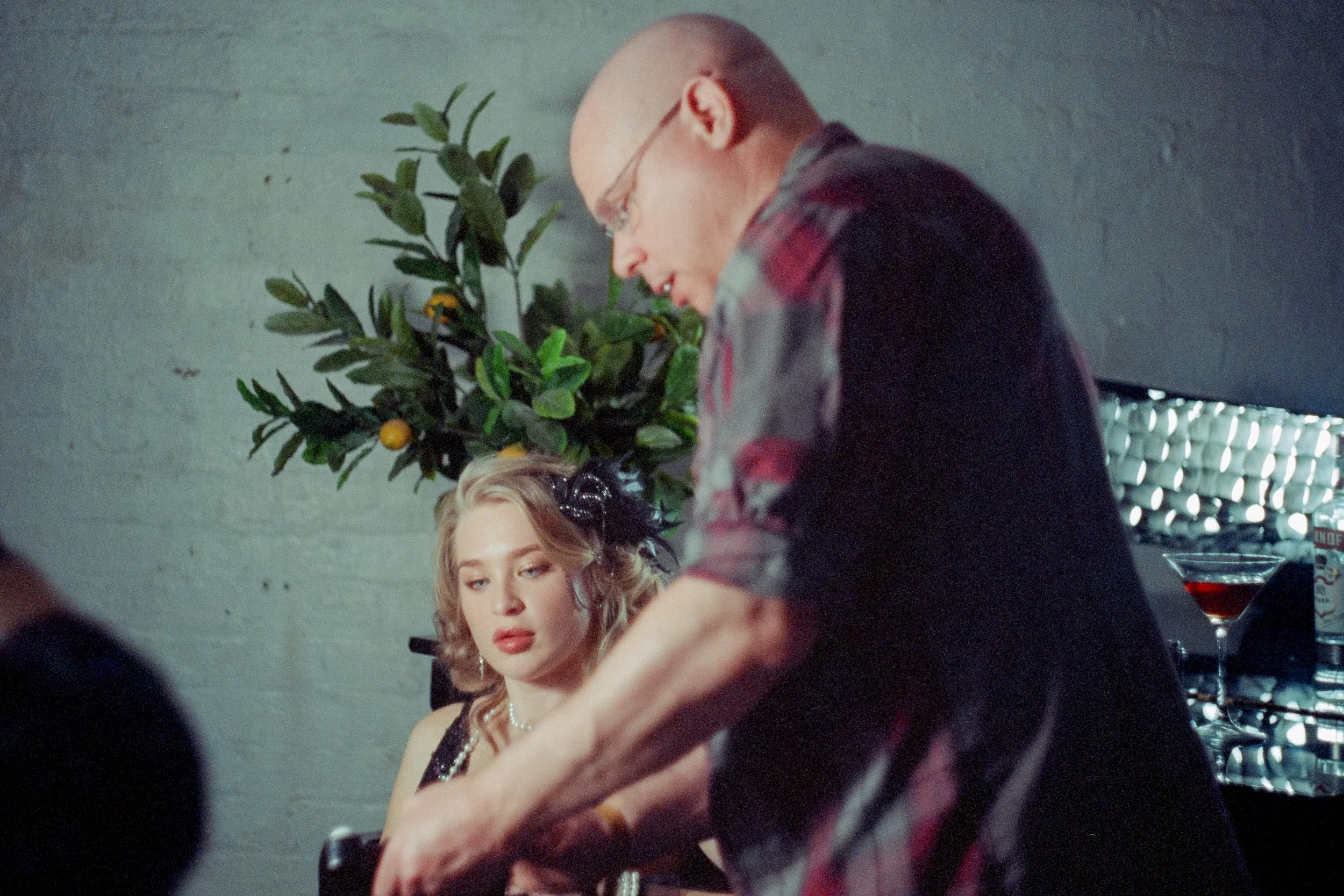
Directing the session as light and composition are carefully refined before the next frame is exposed.
This session is also an example of something fundamental to Liquid Light Lab: the people behind the business are practising professional photographers.
Our work in film development and scanning is informed by direct experience of photography, from planning lighting and selecting optics to directing subjects, exposing film and preparing the final images.
In this studio session, the relationship between those decisions was particularly important. The bare-bulb key, diffusion scrim and controlled strip lighting were chosen to establish the tonal structure of the photographs before exposure. The lenses contributed their own rendering characteristics, while Candido 400's extended latitude allowed the exposure decisions to be carried through development and scanning.
Working professionally on both sides of the negative gives us an understanding of what photographers are trying to achieve when they entrust their film to a lab. We understand the decisions made during exposure because we make those same decisions in our own photographic work.
This experience is part of what informs Liquid Light Lab's approach to chemistry, negative density, high-resolution scanning and the final interpretation of a photograph. It is also central to our technical relationship with Candido Collective, where practical photographic testing and specialist film processing contribute to a deeper understanding of the films themselves.
Candido Film Development & Scanning at Liquid Light Lab
This studio project demonstrates the relationship between professional photography, motion-picture film, ECN-2 processing and high-resolution scanning. From the initial lighting decisions to the finished grade, each stage was considered in relation to the negative and the photographic result.
This approach also underpins our work with Candido Collective. As Candido's Technical Partner and Ambassador, we work with its films both photographically and technically, contributing experience in exposure, film testing, development and digital reproduction.
Candido also recognises Liquid Light Lab as a specialist UK processing partner, providing both C-41 and ECN-2 development alongside high-dynamic-range scanning.
For photographers choosing ECN-2 processing, our service is designed to retain the tonal information and grading flexibility associated with cinema-negative emulsions. Our standard development-and-scanning packages provide approximately 60MP image capture, with full-resolution JPEGs and 16-bit TIFF files included.
We also offer optional professional editing for customers who want further preparation of their digital photographs.
Whether you're photographing a carefully lit studio session or working with Candido film in available light, Liquid Light Lab provides a UK-wide postal developing and scanning service supported by practical photographic experience and specialist technical knowledge.
Explore Candido Film Development & Scanning at Liquid Light Lab
Photography and direction: Martin Brown
Model: Nadia Dutchak
Hair and make-up: Iryna Pasechnik
Colour film: Candido Collective
Black-and-white film: Rollei RPX 400
Development and scanning: Liquid Light Lab
The Cinematic Notebook | Liquid Light Lab
Professional film photography, processing and digitisation.