

Thirty years after A River Runs Through It, actor, writer and filmmaker Craig Sheffer invited me on a road trip through the American West, taking us back towards the Montana landscapes associated with Robert Redford's acclaimed film.
Craig and I have been friends for years, and we share an enthusiasm for analogue photography. With two Leica M5 cameras, a collection of 35mm films and several thousand miles ahead of us, this was an opportunity to revisit a remarkable chapter of Craig's career while making photographs of our own.
From the desert landscapes of Joshua Tree and the neon of Las Vegas to Monument Valley, Yellowstone and Livingston, Montana, the journey became as much about photography and friendship as it was about cinema.
What follows is a photographic account of that journey, captured on film and shaped by the places, conversations and unexpected moments we encountered along the way.

Joshua Tree was a place I wasn’t prepared for. The sand was scorching, and even a few minutes out of the car felt like breathing liquid heat.
It was worth it for the Silbersalz 50D film to work its magic.
Starting in Santa Monica: Barnie’s Beanery and the Call of the Road
We kicked things off at Barnie’s Beanery in Santa Monica. There’s nothing like a good meal and some laid-back conversation to prepare for a long drive. I grabbed a hearty plate of their nachos (Craig insisted they’re a local legend) while he went for a classic burger. Over the clinking of glasses and the low hum of passing conversations, we pored over maps—yes, real paper maps—plotting our route to Montana. Our cameras sat on the table, loaded and eager, and we were ready to go.
Joshua Tree: Desert Magic
Leaving Los Angeles behind, we headed toward Joshua Tree, one of California’s most iconic desert landscapes. Daytime temps soared above 100°F, which gave us the perfect excuse to test out the Silbersalz 50D film. I wanted to see how it handled those stark desert contrasts—the spiky silhouettes of the Joshua trees against the blazing sky. My Leica M5, fitted with a 40mm Voigtlander, did justice to the rugged terrain. The film rendered the shadows with a soft grain that hinted at the shimmering heat.
Little-known fact: Joshua Tree National Park is actually two deserts merging—the Mojave and the Colorado. Perhaps that’s why the terrain shifts so dramatically as you drive through, and it gave us plenty of desert vistas to capture frame by frame.
Route 66 and Roy’s in Amboy: A Slice of Americana

I had to take this shot, even though everyone stops to take it. It’s so iconic, and I think the Silbersalz 50D really brings the blue sky and desert together.
Next up, we hit Route 66, determined to make a stop at the legendary Roy’s Motel and Café in Amboy. This is pure Americana, a neon beacon of mid-century dreams still shining in the desert. We arrived just as the sky was starting to soften into late-afternoon blues and oranges, so I kept to Silbersalz 50D —perfect for oncoming dusk, blue skies and haze. The film’s daylight balance picked up the time faded Roy’s sign beautifully, almost as if we’d stepped back in time. We had a quick chat with the folks running the place, hearing stories of travelers who still make the pilgrimage here for a slice of Route 66 history.
Amboy, by the way, sits at one of the lowest points in the Mojave Desert, which might explain the minor flooding that nearly derailed our plans. A couple of roads were closed off. We had to take a detour, turning our already scenic route into an even more meandering path. If you’re a fan of open desert roads, take note: always check for flash flood warnings; the desert can surprise you.
Battling Floods in the Mojave and Passing Through Las Vegas
Flooded roads meant we had to navigate carefully through the Mojave. We nearly considered turning back and choosing another path, but something about the challenge made the trip feel all the more epic. Shooting with the Leica M5 while Craig manned the second M5 was exciting—I’d pop out of the car window when we hit a safe pull-off, capturing waterlogged desert basins reflecting the sky.
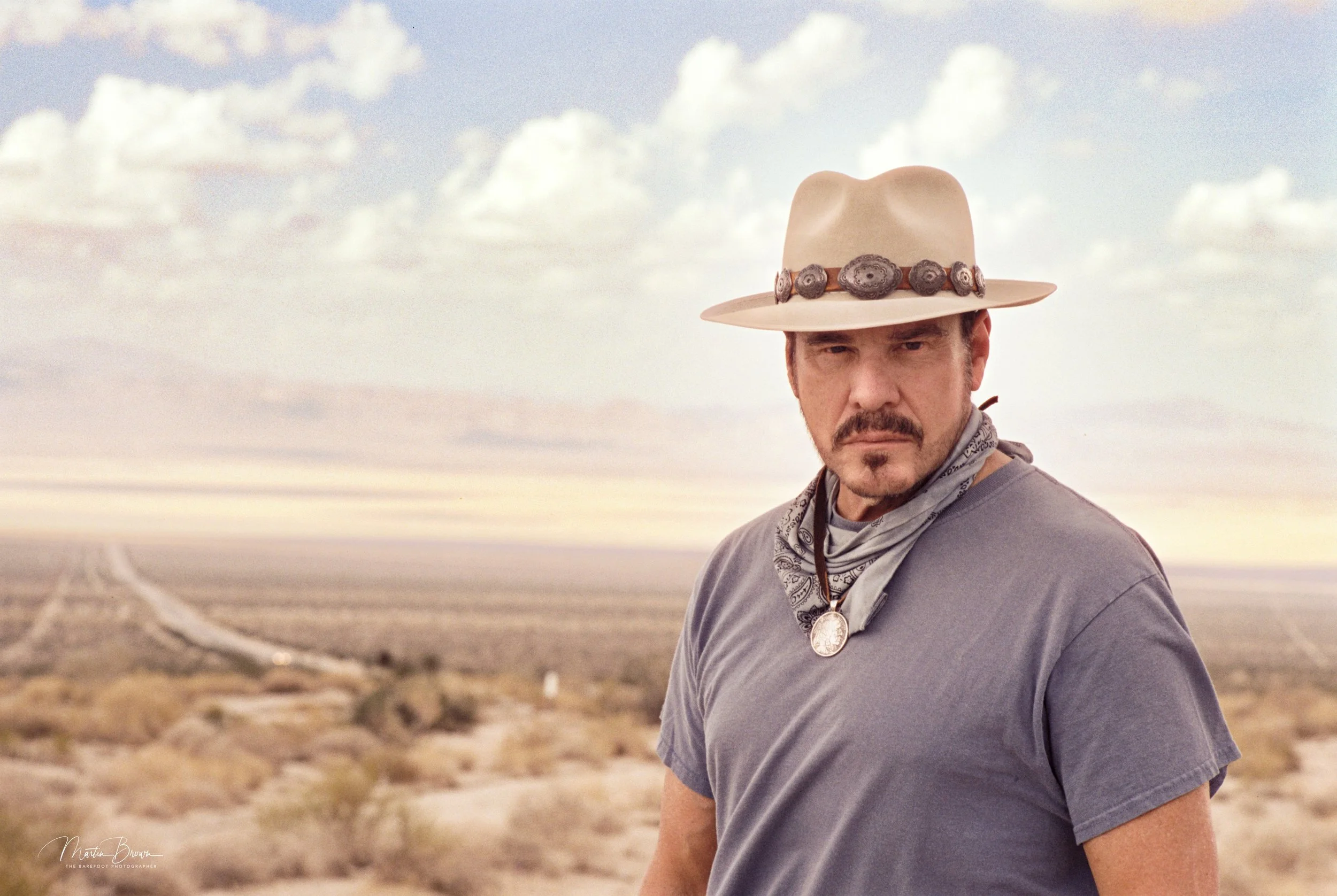
Craig Sheffer in the desert, photographed on the Leica M5 with the Voigtländer 40 mm f/1.2 and Silbersalz 50D — a cinematic portrait shaped by the soft colour latitude of true 35mm film.
We took a short break in Las Vegas, if only to refuel and snap a few neon-lit shots with Cinestill 800T. The bright lights and perpetual hustle might have been a stark contrast to the desert’s emptiness, but that’s the magic of a road trip: you can encounter the quiet of the open road one minute and the dazzling glow of the Strip the next.

You’d think Las Vegas would be the place to break out Cinestill 800T.
The truth is, I don’t like the film halation effect, and after this trip I switched to Vision3 500T. Here is one image that didn’t suffer the halation.
Salt Lake City and the Grand Canyon North Rim
From Vegas, we set our sights on Salt Lake City, taking a brief pause to stretch our legs and snap some cityscapes. Silbersalz film brought out the crisp blues of the Utah sky, and the Leica’s rangefinder made manual focusing a breeze for quick street snaps. We didn’t linger too long, though, as the Grand Canyon North Rim awaited.
The North Rim offers a less crowded, more tranquil experience compared to the South Rim. We spent the night in a log cabin that felt like something out of a childhood storybook—wood creaking in the wind, stars glinting overhead. Once it got dark enough, the Milky Way spread out across the sky. If you’ve never seen it, it’s like a cosmic highway of light over the canyon. Cinestill 800T at night can yield stunning results, but I found that shooting on Silbersalz film brought an ethereal softness to the starry sky.
A fun tidbit: The Grand Canyon sits at over 8,000 feet in elevation on the North Rim, making nights significantly cooler. The temperature shift gave us some welcomed relief after the Mojave’s scorching heat.
Monument Valley: The Icons of the American West
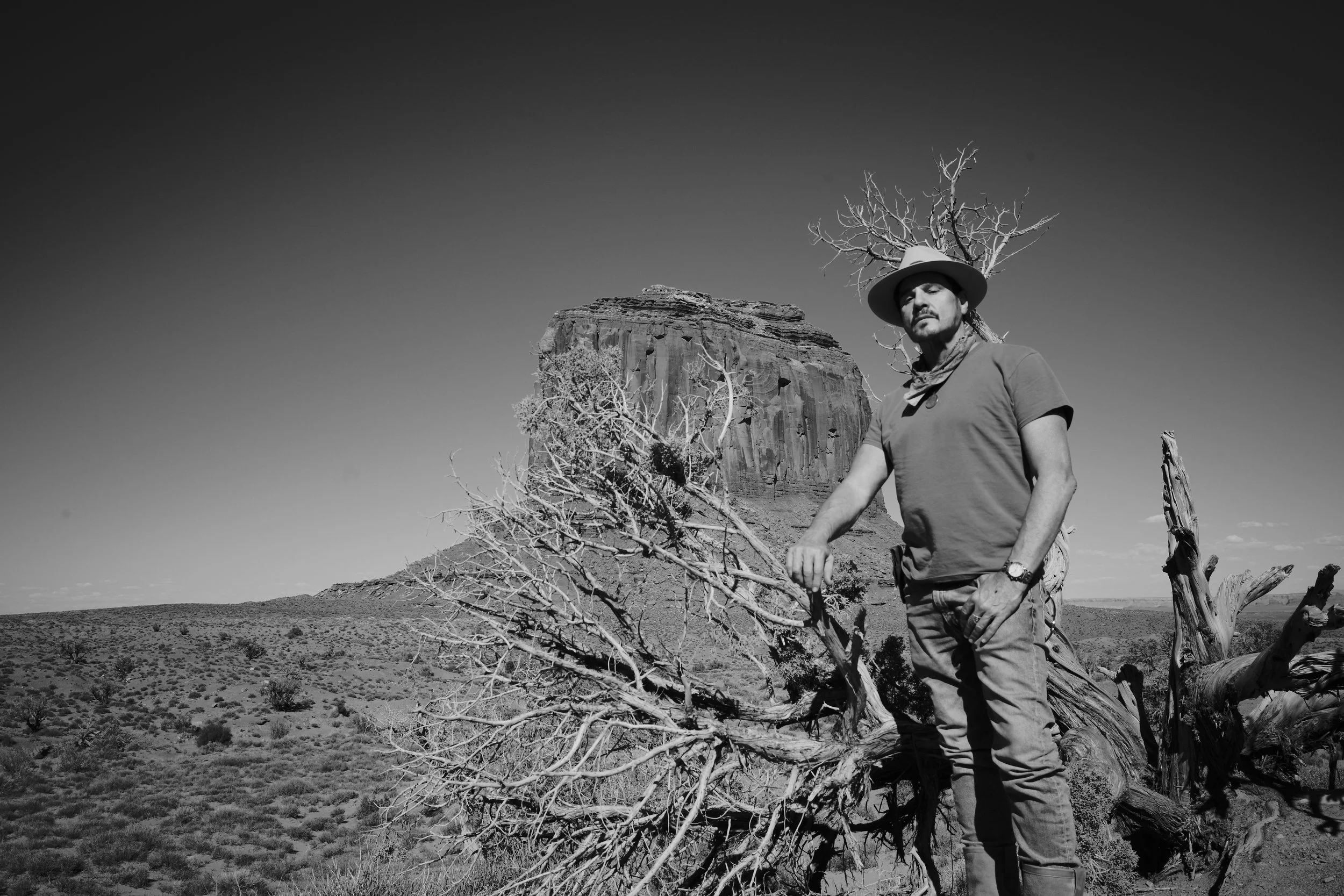
Driving east, we arrived at Monument Valley, famous for its towering red-sandstone buttes. These monoliths have starred in countless Westerns, yet seeing them in person is something else entirely. Even Craig, who’s been on numerous film sets, was taken aback by the valley’s grandeur. I tested both Washi D for black-and-white drama and Silbersalz 50D for those vivid desert hues. The Leica M5’s meter did a solid job of balancing bright desert light and darker shadows cast by the towering buttes. Meanwhile, we swapped John Wayne lines and planned a second trip to see the entire Monument Valley route, which spans over 20 miles on its own.

The Monument Valley trail is beautiful, and beyond its cinematic representations.
It’s the kind of location that makes me want to return with drones, more film and models to shoot amazing portrait work.
Jackson Hole, Large Format Temptations, and a Sausage Biscuit Craving
Next on the list was Jackson Hole, Wyoming, a haven for outdoor enthusiasts. We only planned a quick stop, but ended up lingering longer than expected after discovering a camera shop that had a gorgeous large format camera. I can’t deny it—it was tempting to add a new piece of gear to the arsenal. There’s something about large format that’s akin to stepping into photography’s earliest days. Still, with two Leica M5s and a pile of film in tow, I somehow mustered the self-control to walk away. Craig almost didn’t, and nearly bought the camera, lens and plates!
Before leaving, hunger struck. I had an overwhelming craving for a sausage biscuit of all things, which seems oddly specific, but I lived for several years in Tennessee and hadn’t eaten one since the mid-1990’s! Craig found a nearby café, and we devoured breakfast sandwiches while we discussed the possibilities of large format.

We wanted this camera.
Unfortunately, desire is free — shipping is not.
We didn’t buy the camera.
Yellowstone and Old Faithful
We couldn’t pass through this region without visiting Yellowstone National Park. Craig insisted we see Old Faithful, which didn’t disappoint, erupting right on cue. The smell of sulfur and the faint roar of geothermal vents made for an otherworldly experience. Using the Silbersalz film, the colors of the hot springs and surrounding landscapes popped: deep blues, rusty reds, and vibrant yellows. The Leica’s rangefinder focused effortlessly on the plumes of steam, and again, I found the manual experience far more engaging than snapping away on an auto-everything digital camera.
Yellowstone is one of the largest active volcanic systems on the planet. The ground beneath you is very much alive, heating water to a boil and creating those spectacular geysers.
Finally Reaching Livingston, Montana
Our last leg took us into Livingston, Montana, the place where A River Runs Through It was brought to life three decades ago. Craig was visibly nostalgic. We walked the streets, recalling scenes from filming and how Robert Redford and Brad Pitt helped shape a story that resonates with so many. Naturally, I burned through a couple rolls of Washi D, capturing Craig in front of landmarks he remembered from the shoot. The black-and-white look felt fitting for a town that time hasn’t completely overtaken, where glimpses of the old days still peek through.
Livingston is known for its historic downtown and proximity to the Yellowstone River—fitting for a film that revolves around fly fishing and family ties. We spent our evenings reminiscing about the people Craig worked with and how the region’s natural beauty made it an ideal backdrop for a classic story.
The trip didn’t just produce photographs. It also sparked a deeper conversation about lighting — what it feels like to work inside a deliberately shaped frame, and how contrast changes behaviour. We later sat down to explore that properly in a separate interview focused entirely on cinematic lighting and portrait practice.




Wrapping Up: Back to LA for Sushi
Our return route took us through Wyoming once more, winding our way through stunning vistas that never seemed to get old. By the time we rolled back into LA, we decided to celebrate with a sushi night among friends—quite the contrast from the sausage biscuit pit stop and the barbecue-heavy roadside diners we’d encountered earlier. It felt like the perfect way to ease back into city life after our epic journey across six states (California, Arizona, Nevada, Utah, Idaho, Wyoming, and Montana).
Reflecting on Film, Friendship, and the Road
Throughout this trip, film photography became more than just a medium; it was our companion. The Leica M5 cameras forced us to slow down and focus on the subtle details: the shadows dancing on Joshua Tree’s boulders, the neon glow of Roy’s in Amboy, the majesty of the Grand Canyon’s star-laden sky, and the evocative forms of Monument Valley. Each roll of Washi D, Cinestill 800T, and Silbersalz told a different chapter of our adventure, capturing both the natural wonders and the light hearted camaraderie that epitomizes our friendship.

"The road trip crew: One king, one bandit, and their royal fluffy navigator." 🚐👑🐶😆
Looking back on this Los Angeles to Montana road trip, it was more than just a drive to commemorate the film’s anniversary. It was a celebration of film photography, brotherhood, and the power of open roads to bring people closer. Maybe we didn’t buy that large format camera (yet), but we took home a priceless collection of memories and negatives that will forever remind us why we love the slow, tactile process of analogue film shooting. If you’re considering a similar route, be ready for extremes in weather, unexpected detours, and awe-inspiring landscapes—and bring enough film to do it all justice. After all, the best part of a road trip is that it’s never just about the destination, but the stories you gather on the way.
This journey remains a reminder of why analogue photography matters to me. The anticipation of developing a roll, seeing what the negative has recorded and discovering how the photographs come together is as rewarding now as it was then.
That relationship between photography, film and chemistry remains central to our work at Liquid Light Lab, where we specialise in professional film developing and high-resolution scanning.
By Martin Brown | The Cinematic Notebook, Liquid Light Lab