

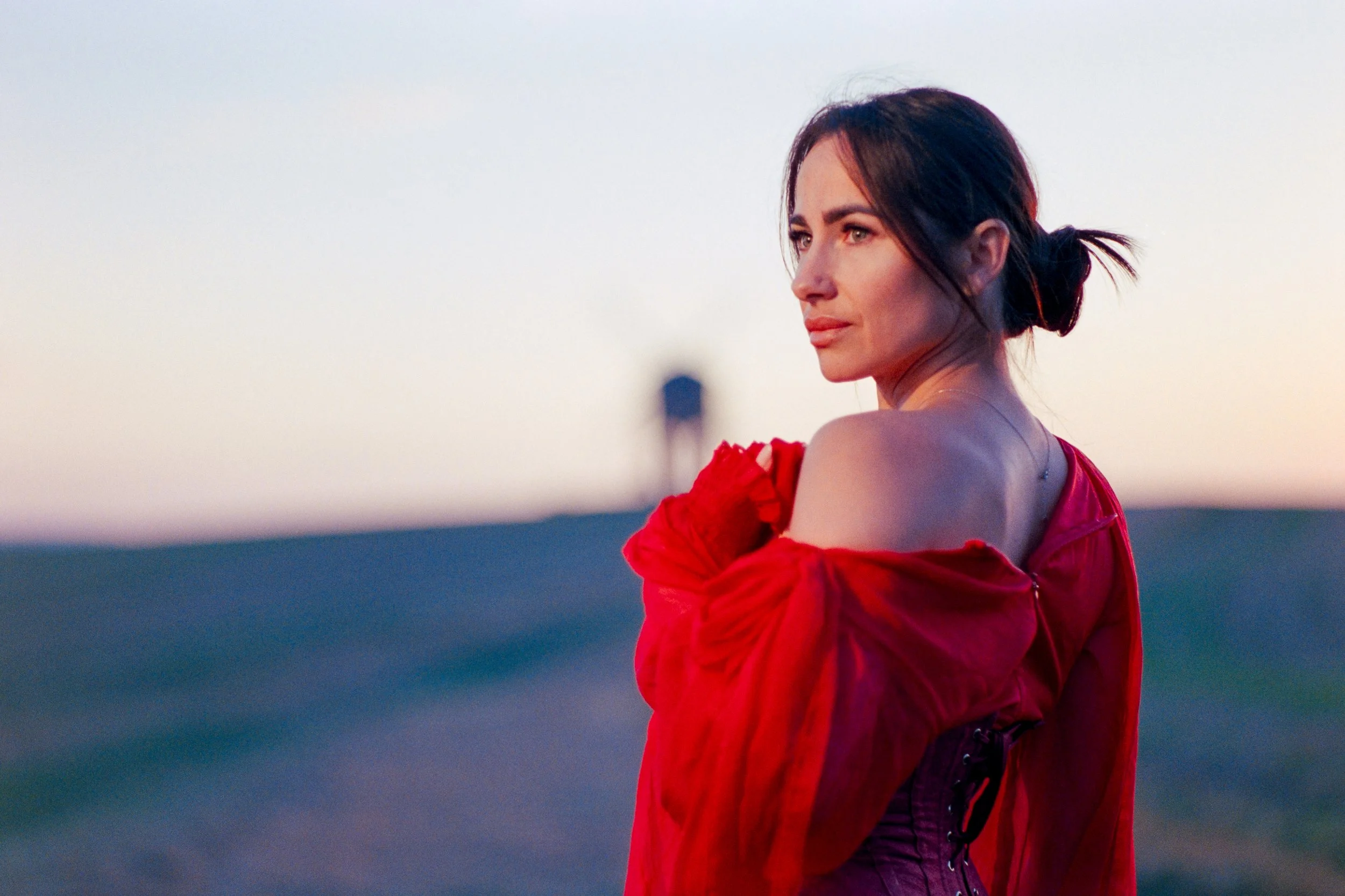
A portrait photographed on Candido 35mm colour negative film at Chesterton Windmill, Warwickshire. The final evening light illuminates the subject's face, while the distant windmill falls softly out of focus against the cooling landscape. Developed and scanned at Liquid Light Lab, the photograph illustrates how colour separation, controlled exposure and careful scanning preserve the atmosphere of a fleeting moment.
There is something distinctive about photographing people on film in an open landscape. The light changes, the surroundings become part of the composition, and the photographer must make deliberate decisions about exposure, positioning and the moment of capture.
This portrait session at Chesterton Windmill, near Leamington Spa in Warwickshire, was photographed by Martin Brown using Candido 35mm film, with the exposed negatives subsequently developed and scanned at Liquid Light Lab.
The photographs bring together two important aspects of our work: continuing professional photographic practice and our international technical partnership with Candido Collective. They also demonstrate why understanding the complete photographic process matters. The final image begins long before a negative reaches the developing chemistry.
Photographing at Chesterton Windmill
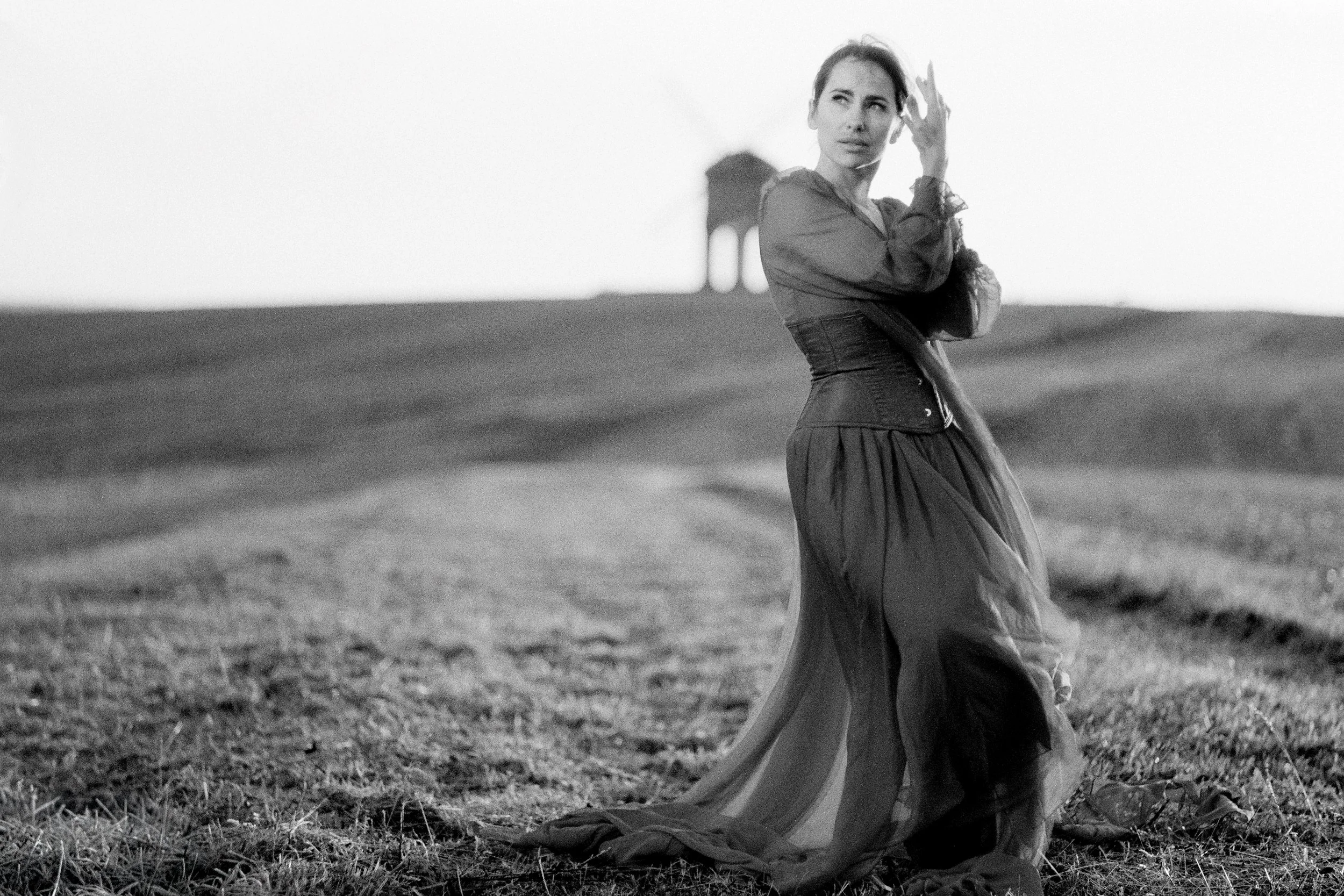
Chesterton Windmill stands in an exposed landscape overlooking the Warwickshire countryside. Its distinctive architecture provides a recognisable setting, but the photographic possibilities extend beyond the building itself. The openness of the location creates opportunities to work with distance, natural light and the relationship between a person and their surroundings. Rather than treating the windmill as a backdrop that must dominate every frame, the location becomes another element within the composition.
For this session, the aim was to produce portraits with a sense of atmosphere and place, while keeping the person being photographed at the centre of the work. The red dress visible in the photographs introduces a strong visual element against the surrounding landscape. Combined with the architecture and changing natural light, it provides opportunities for both wider environmental portraits and more intimate compositions.
These decisions are part of working as a professional photographer. The location matters, but it is the photographer's understanding of light, composition and the subject that determines how successfully those elements come together.
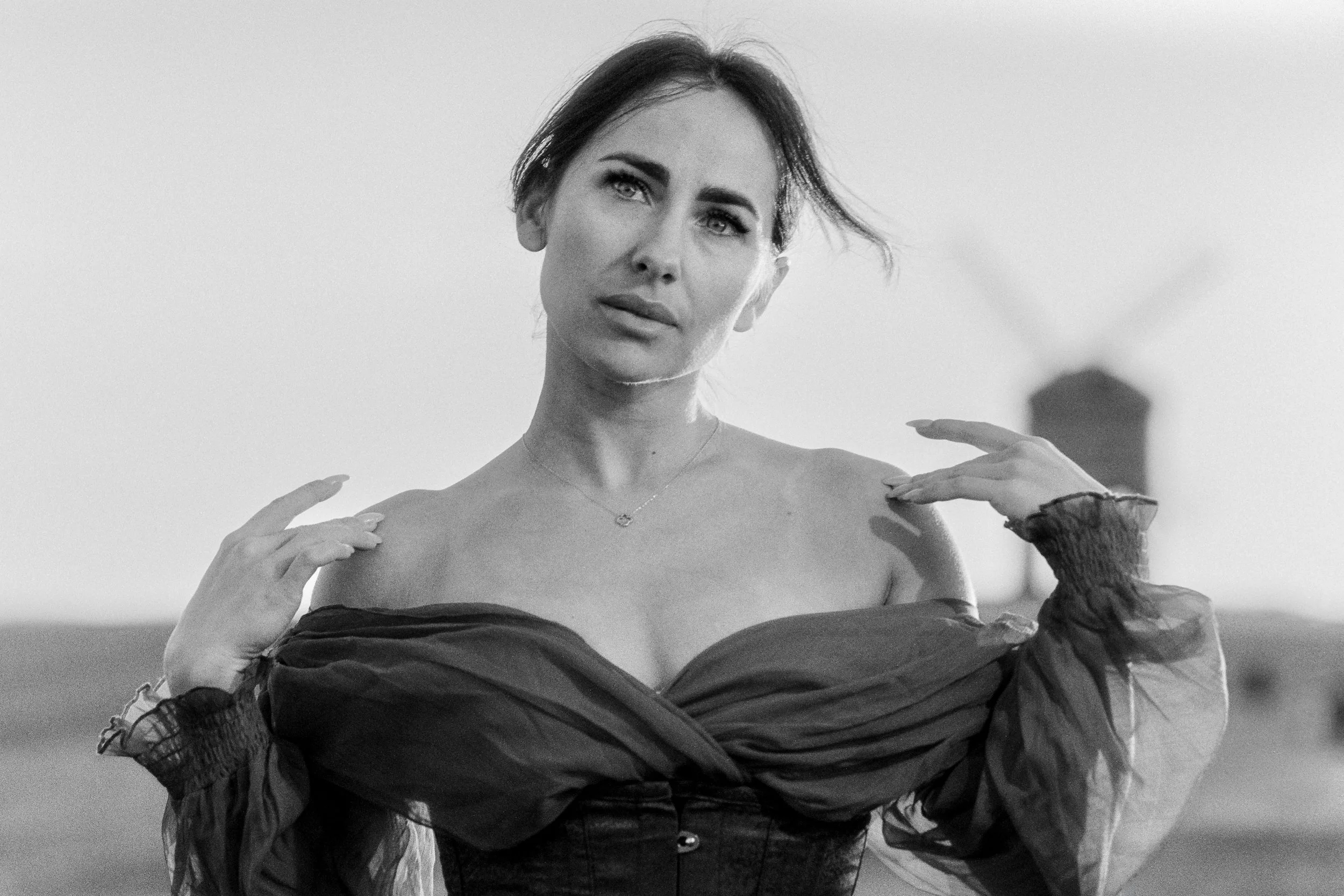
A close-framed portrait from the session at Chesterton Windmill, Warwickshire. Presented in black and white, the composition draws attention to gesture, the folds of the dress and the changing natural light. The separation between illuminated skin, darker fabric and the softly rendered background demonstrates the importance of tonal detail in professional film photography and scanning at Liquid Light Lab.
Working With the Last Light of the Day
Natural light is rarely static, particularly towards the end of the day. As the sun lowers, its angle changes the relationship between illuminated surfaces and shadow. Faces acquire more directional modelling, while the landscape develops differences in brightness and colour that are less apparent under overhead midday light.
Chesterton Windmill provides relatively little shelter from those changes. The photographer must work with the available conditions rather than expect them to remain consistent, and this is where positioning becomes particularly important. Small adjustments in the subject's orientation can change how light falls across the face. A change in camera position alters the relationship between the person, the horizon and the windmill. Even relatively modest movements can produce noticeably different compositions without changing the location.
Throughout this session, direction focused on posture, eye line and positioning rather than continually introducing new poses. The purpose was to create a coherent series of portraits while allowing the light and setting to provide natural variation.
There is a discipline to this approach. Film offers no immediate opportunity to inspect the captured negative, so exposure and composition must be considered carefully at the moment the photograph is made.

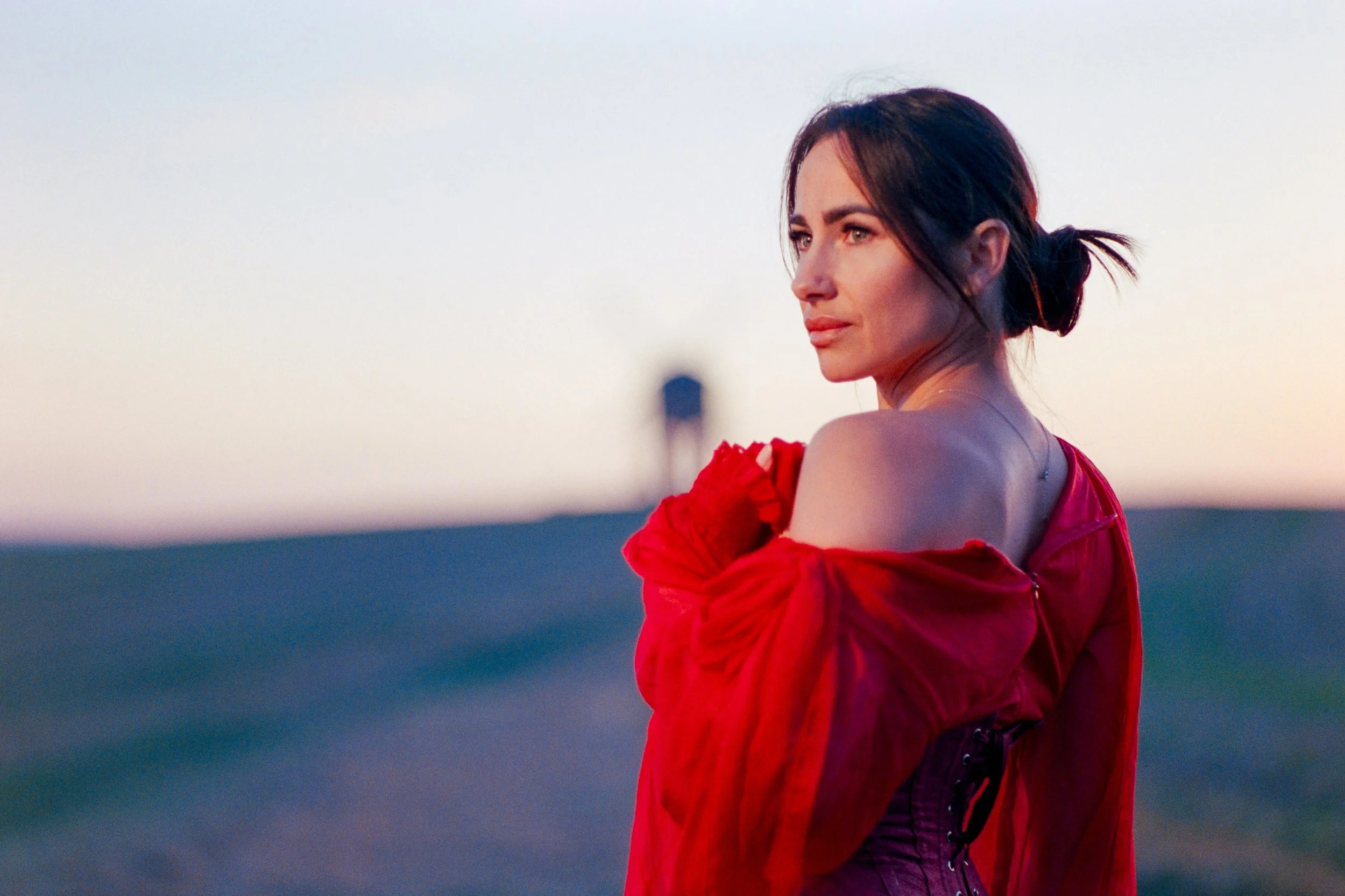
Photographed on Candido 35mm colour negative film at Chesterton Windmill, Warwickshire. The setting sun creates a demanding exposure range, balancing bright highlights against the more subtle tones of the subject's face and red dress. Developed and scanned at Liquid Light Lab, the portrait demonstrates Candido film's use in professional location photography and the importance of preserving tonal separation throughout the photographic process.
Why Candido Film?
The colour photographs here were made on film from Candido Collective, an international photographic film company with which Liquid Light Lab maintains a substantial technical relationship.
Candido's range includes colour negative films derived from motion-picture emulsions, giving still photographers access to characteristics originally developed for cinematography.
These films offer different exposure speeds, colour balances and tonal responses, allowing photographers to select an emulsion according to the lighting and photographic result they intend to achieve.
For location portraiture, colour negative film provides a useful combination of exposure latitude and tonal flexibility. When correctly exposed, developed and scanned, it can retain subtle differences between illuminated skin, darker clothing, the landscape and brighter areas of the scene. This flexibility is valuable when working outdoors, where the relationship between subject brightness and background illumination can change considerably during a session.
A negative still needs sufficient exposure to record useful shadow information, and the resulting density must be carried through development and scanning without unnecessarily restricting what the photographer can achieve with the final image.
This is one reason we regard film selection, exposure and processing as connected decisions rather than independent stages.
The Candido and Liquid Light Lab Partnership
Our relationship with Candido extends considerably beyond using its film for photography. As Candido's Technical Partner and Ambassador, we contribute directly to the technical information supplied to photographers and laboratories internationally. This includes authoring Candido's online technical data sheets and the printed instructions included with every roll of film. Our work has also involved evaluating new emulsions, including testing the company's 100-speed C-41 film and recommending its ISO 100 rating.
These responsibilities require a practical understanding of how films behave under different exposure conditions, how development chemistry influences their characteristics and how the information recorded in a negative is reproduced during scanning. Our professional photography experience is an important part of that knowledge.
A technical recommendation has greater value when it is supported by experience actually photographing with the emulsion, evaluating the negatives and examining the resulting scans. This Chesterton Windmill session is an example of Candido film being used in working photographic practice, rather than simply discussed through specifications.
Our collaboration also encompasses professional studio photography and commissioned assignments. You can read more about the technical work, film testing and photography behind this relationship in Candido Film & Liquid Light Lab: Inside Our Technical Partnership.




From Exposure to the Finished Negative
The photographic decisions made at Chesterton Windmill established what the film could record. Development and scanning were responsible for carrying that information into the finished photographs.
At Liquid Light Lab, we work with C-41, ECN-2 and traditional black-and-white development, selecting the appropriate process for each supported film and the photographer's requirements.
The distinction between C-41 and ECN-2 is particularly relevant to motion-picture-derived films. Although compatible Candido stocks may be processed in either chemistry, the two processes use different colour developing agents and produce different negative characteristics. Development influences contrast, dye formation and colour response before scanning begins. The correct choice for creative vision depends on the particular stock and the intended photographic result.
For a professional photographic series, consistency matters. The relationship between exposures across a roll should remain coherent, allowing the finished photographs to be interpreted and graded as a body of work rather than as unrelated images.
Once developed, the negatives from this session were scanned at Liquid Light Lab.
Why Scanning Matters to Film Portraiture
The negative is the original photographic record, but most people will encounter the finished photograph as a digital image.
Scanning plays a substantial role in how the film's tonal and colour characteristics are reproduced. Skin tones contain subtle variations in colour and brightness. Directional light creates transitions across the face that can be easily flattened by excessive contrast or inappropriate tonal adjustments. Bright areas of the landscape may contain information that becomes difficult to reproduce if the scanning system cannot adequately capture the density range of the negative.
Liquid Light Lab uses our specialist chamber-based scanning system, with high-resolution capture, precision optics and controlled illumination.
Our standard 35mm scanning workflow produces images of approximately 60 megapixels. Development-and-scanning customers receive both full-resolution JPEG files and 16-bit TIFF files, providing convenient finished images alongside files intended for further photographic editing.
Resolution is only one part of this process. Tonal separation, colour reproduction and the ability to retain useful information across the negative's density range are equally important. The objective is not to impose the same appearance on every roll of film. It is to reproduce the negative with sufficient quality and flexibility for the photographer's intended result.
Our article Why Film Scans Look Different From One Film Lab to Another explores these distinctions in more detail.
Professional Photography and Technical Knowledge
The Chesterton Windmill portraits demonstrate an important part of Liquid Light Lab's background. The people behind the lab are not removed from the photographic process. Our experience comes from years of professional photographic work, including location portraiture, studio productions and assignments involving people from the film industry. This experience gives us deeper insight into how we approach developing and scanning other photographers' negatives.
We understand the decisions that precede exposure: choosing the film, interpreting available light, directing a subject, selecting an appropriate exposure and considering how the negative will ultimately be reproduced. We also understand the importance of maintaining the integrity of those decisions once the film arrives for processing.
Our international technical collaborations build on the same experience. Whether we're evaluating a new film stock for Candido, producing technical documentation or examining the results of a photographic assignment, the relationship between exposure, negative density, chemistry and scanning remains central.
These photographs from Chesterton Windmill are one practical example of that relationship.
Your Film at Liquid Light Lab
Liquid Light Lab is an independent professional film lab based in Royal Leamington Spa, serving photographers throughout the United Kingdom through our postal developing service. We provide C-41, ECN-2 and black-and-white processing for supported 35mm and 120 films, together with high-resolution scanning.
Our work with Candido is part of a wider commitment to understanding photographic emulsions, their development requirements and the technical decisions that influence the finished photograph. Whether you're working on a professional portrait assignment, documenting everyday life or exploring a new film stock, the objective is the same: develop the negative correctly and reproduce the photograph with care.
Explore Film Developing & Scanning at Liquid Light Lab
Film: Candido Collective
Development and scanning: Liquid Light Lab
The Cinematic Notebook | Liquid Light Lab