

Kodak VISION3 motion-picture film offers still photographers an exceptional combination of exposure latitude, subtle tonal transitions and creative control. But to realise those characteristics, the relationship between exposure, ECN-2 development and high-dynamic-range scanning matters just as much as the film itself.
Why choose a motion-picture colour negative film when established C-41 stocks such as Kodak Portra, Ektar and Gold already offer excellent results? The answer isn't just the pursuit of a cinematic look. Kodak VISION3 was developed for professional motion-picture production, where a negative may need to accommodate extreme differences in illumination while retaining the tonal and colour information required for subsequent grading.
This design has considerable value in still photography. Whether photographing a carefully lit portrait, working with mixed illumination, recording a landscape in difficult light or shooting documentary images under changing conditions, VISION3 provides a distinctive photographic starting point.
At Liquid Light Lab, we work with these emulsions as practising professional photographers, film technicians and specialist scanning practitioners. Our experience also extends to international technical work with Candido Collective, including film testing, exposure guidance and processing recommendations.
This article explores why photographers choose VISION3, what makes its photographic characteristics different, and why ECN-2 development and appropriate scanning are essential to obtaining the intended results.
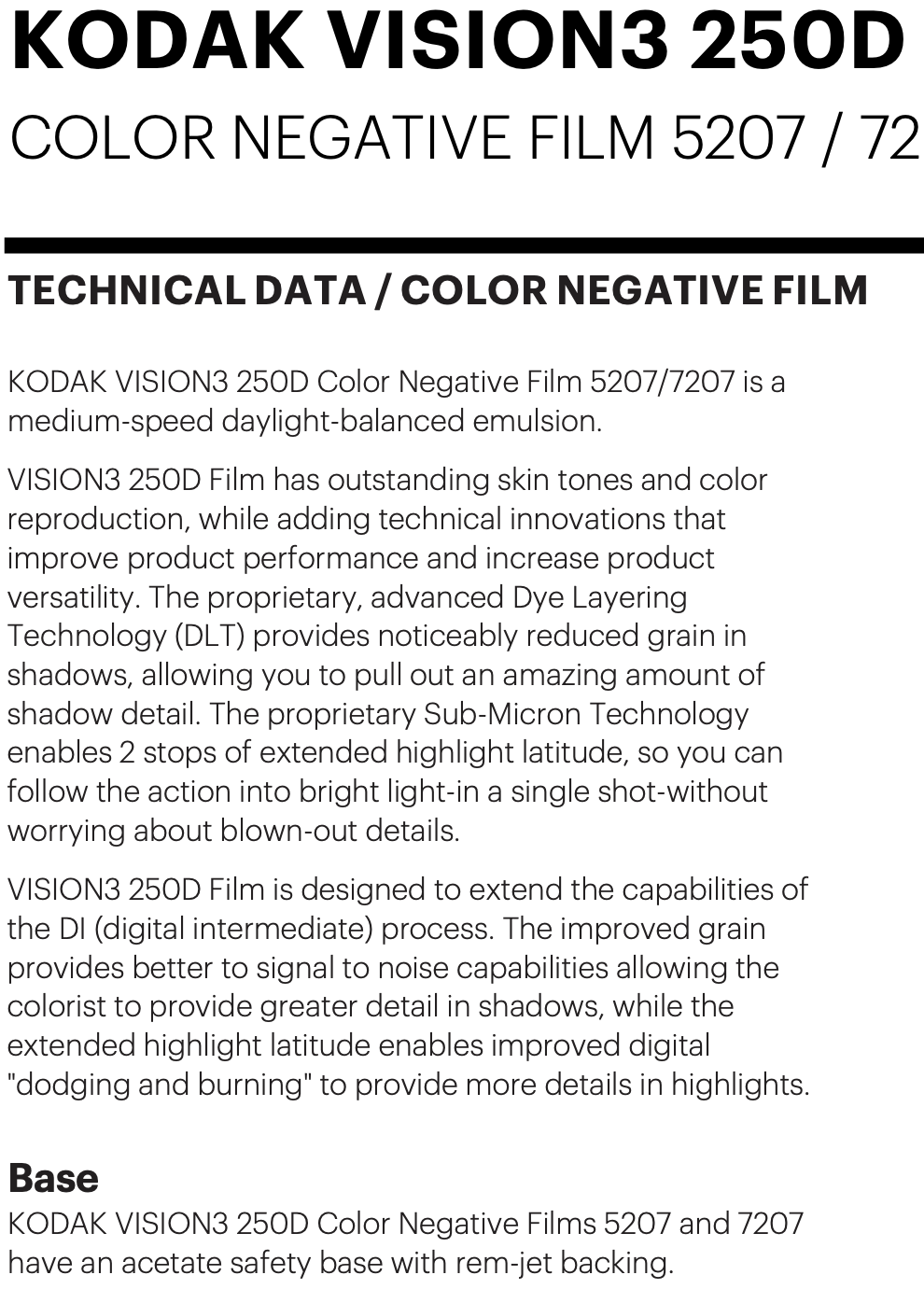
Kodak's technical documentation for VISION3 250D (5207/7207) describes the emulsion's advanced Dye Layering Technology, improved shadow grain and two additional stops of highlight latitude. Designed for digital-intermediate grading, these characteristics demonstrate why correct ECN-2 development and high-dynamic-range scanning are important to preserving the film's photographic information. The document refers to the original remjet-backed formulation, preceding Kodak's transition to AHU.
What Makes Kodak VISION3 Different?
Kodak VISION3 is a family of professional colour-negative motion-picture films developed for cinematography. Its emulsions were engineered to record detailed photographic information across a wide range of scene brightness, producing negatives suitable for colour timing, digital intermediate work and subsequent reproduction.
Modern VISION3 films incorporate technologies intended to improve grain performance, colour reproduction and the retention of information across the exposure scale.
Kodak's VISION3 250D technical documentation demonstrates the importance of extended highlight latitude and the ability to recover detail when photographing scenes with challenging illumination.
Three characteristics are particularly important to still photographers:
Extended exposure latitude. The negative can record a substantial range between darker and brighter areas of a scene, giving the photographer more information to work with during subsequent reproduction.
Controlled negative contrast. VISION3 is intended to provide a negative whose tonal relationships can be shaped during colour timing or grading, rather than establishing the complete positive-image contrast during development.
Fine tonal and colour separation. The film's characteristic curves and dye response allow subtle differences in brightness and colour to be retained across the negative, provided exposure, processing and scanning are appropriate.
These qualities are not exclusive to motion-picture film. Professional C-41 films also offer considerable latitude and sophisticated colour reproduction. The distinction is that VISION3 was designed around a motion-picture negative workflow, in which retaining information for subsequent grading is a primary consideration.
Exposure Latitude: Why It Matters in Real Photographs
Exposure latitude is sometimes discussed as though it simply allows a photographer to make mistakes, but this considerably understates its creative value. In practical photography, we rarely have complete control over every part of a scene unless shooting in a studio.
A portrait may contain bright window light and deep interior shadows. A street photograph may combine direct sunlight with shaded architecture. A night scene may include intensely illuminated signs alongside areas receiving very little light. The photographer must decide which parts of the scene are important and where to place the exposure, and VISION3's extended latitude provides flexibility in making those decisions.
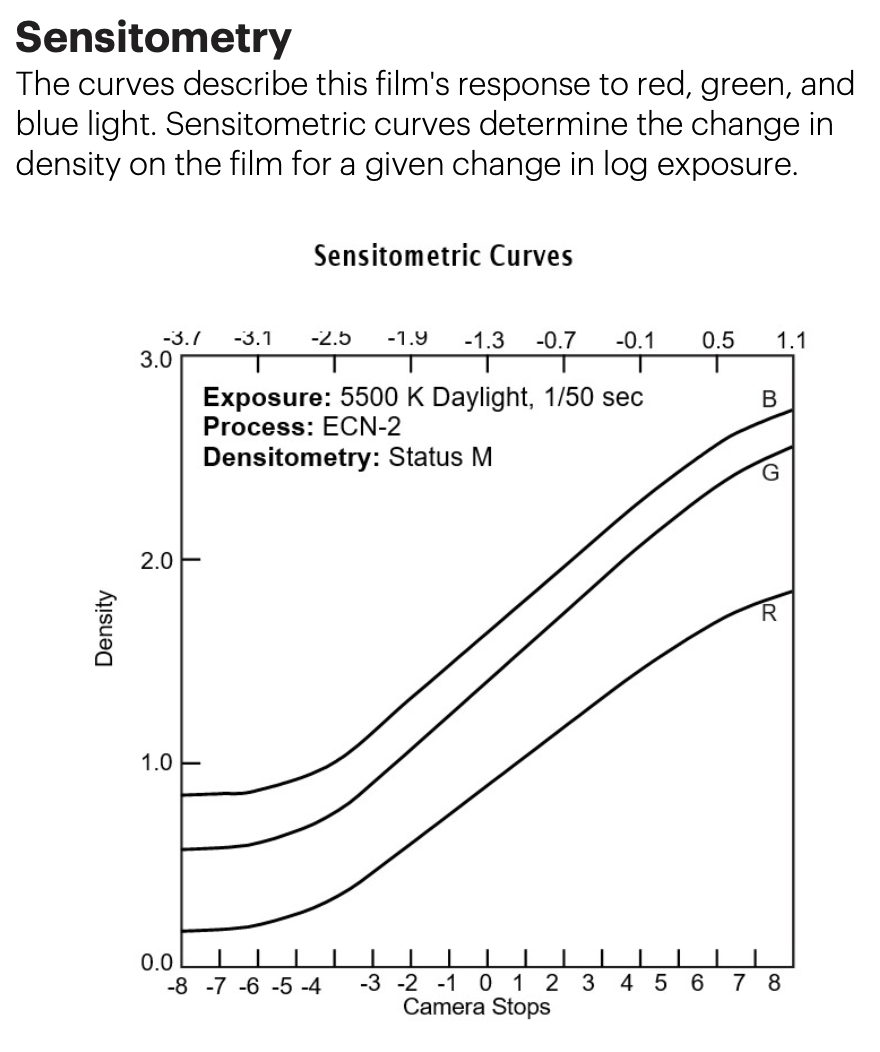
Sensitometric curves illustrating the response of Kodak VISION3 colour negative film developed in ECN-2. The red, green and blue curves show how negative density changes with exposure across shadows, midtones and highlights. The gradual response through the upper exposure range helps explain VISION3's extended highlight latitude and the importance of preserving those density differences through professional development and high-dynamic-range scanning at Liquid Light Lab.
Highlight Retention
One of the important characteristics of Kodak VISION3 is its ability to record information in very bright parts of a scene.
In a colour negative, greater scene exposure produces greater negative density.
The film's highlight response allows substantial information to be recorded in those dense regions, provided the exposure remains within the emulsion's useful range. This matters when photographing bright windows, reflective surfaces, clouds, pale clothing or subjects illuminated by hard directional light.
Rather than forcing every bright area towards a fixed positive-image white point during capture, the negative can retain tonal differences that may later be positioned during scanning and grading. The practical result is greater control over how highlights are represented in the finished photograph.
Shadow Detail and Colour
The darker parts of a photograph are equally important. Shadow exposure determines how much useful information is recorded in the less-exposed regions of the negative.
VISION3's emulsion design includes technologies intended to improve grain performance and the reproduction of low-light information, though extended latitude doesn’t eliminate the need for correct exposure. A severely underexposed shadow cannot be restored simply by selecting ECN-2 development or increasing digital brightness afterwards.
The useful approach is to understand the film's sensitivity, expose deliberately and preserve the recorded information through development and scanning.
Why VISION3 Can Be Used for More Than Studio Photography
Motion-picture film is often associated with professional lighting rigs, controlled sets and carefully measured exposure. These are important parts of cinematography, but they aren’t prerequisites for using VISION3 successfully. Many of its most useful characteristics become apparent when the photographer cannot control the light.
Portrait and Studio Photography
Under controlled lighting, VISION3 allows photographers to establish relationships between highlights, midtones and shadows at exposure, then refine the finished image through grading. Directional lighting, large differences between key and fill, and complex colour relationships can all be explored through the negative's response.
Our Candido studio photography project demonstrates this approach, following the photograph from lighting and exposure through ECN-2 processing, high-resolution scanning and final colour grading.
Street and Documentary Photography
Street photography frequently involves changing light, unpredictable subjects and little opportunity to adjust a scene. VISION3's exposure latitude can be useful when moving between direct sunlight, shaded streets, shop interiors and reflected illumination. It allows the photographer to concentrate on the moment while retaining flexibility in how the recorded tones are later reproduced.
Landscapes and Available Light
Landscape photography often involves a wide brightness range, particularly around sunrise, sunset or when photographing towards a bright sky. The film's highlight characteristics can be particularly useful when the photographer wants to retain differences between bright clouds, reflective surfaces and darker landscape elements.
Night and Mixed-Light Photography
Tungsten-balanced VISION3 stocks are particularly interesting under artificial illumination. Streetlights, illuminated interiors, signage and mixed colour temperatures can create complex colour relationships.
The appropriate choice of film, exposure and subsequent grading allows photographers to decide how those relationships should appear rather than forcing every scene towards a neutral interpretation.
The advantage of VISION3 is not that it requires a controlled photographic environment. It is that its negative characteristics provide control over the reproduction of photographs made in many different environments.
Choosing the Right Kodak VISION3 Film
The VISION3 family includes emulsions intended for different lighting conditions and exposure requirements.
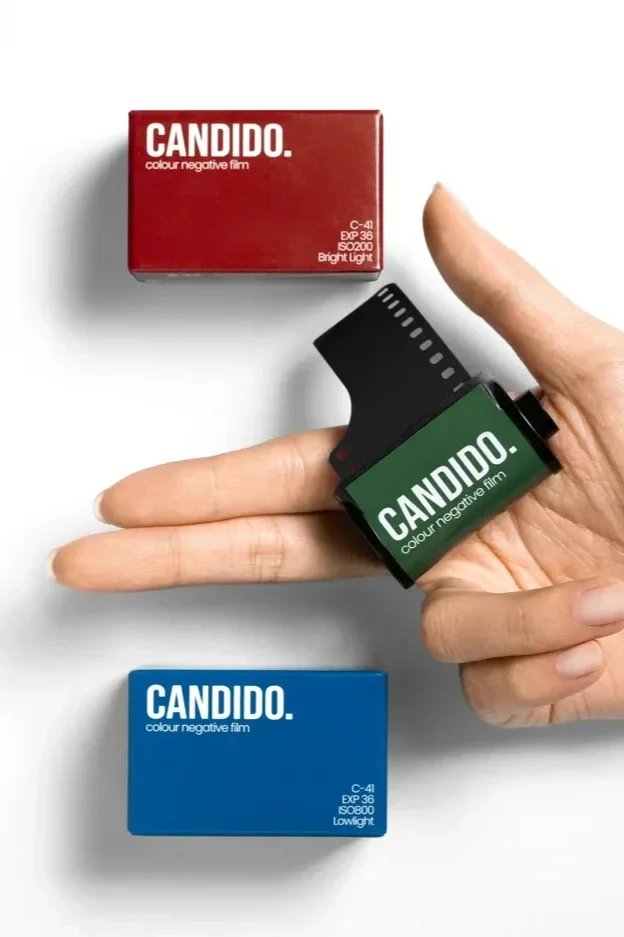
Candido Collective's 35mm colour negative film range. As Candido's Technical Partner and Ambassador, Liquid Light Lab contributes to film testing, exposure recommendations, technical data sheets and the instructions supplied with every roll. This international collaboration brings together film manufacturing, professional photography, C-41 and ECN-2 processing, and high-resolution digitisation.
VISION3 50D
A fine-grained, daylight-balanced colour negative suited to bright conditions where low grain and detailed reproduction are important. It is particularly attractive for landscapes, architectural photography and well-lit subjects.
VISION3 250D
A daylight-balanced film offering a useful balance between sensitivity, grain performance and exposure latitude. It is highly versatile for outdoor photography, portraits and scenes containing difficult combinations of light and shadow.
VISION3 200T
A tungsten-balanced motion-picture negative designed for artificial lighting environments. It is particularly useful for studio photography and scenes where tungsten illumination forms an important part of the intended colour response.
VISION3 500T
A higher-speed tungsten-balanced film suited to lower illumination levels, night photography and motion-picture environments where available light is limited. Its speed provides greater flexibility in challenging conditions, while its colour balance makes it especially interesting for night scenes and mixed illumination.
Film choice should always consider the available light, the subject and the intended photographic result. The speed printed on a cinema-derived still-photography cassette may also reflect the supplier's tested recommendations rather than simply reproduce the rating of the originating motion-picture emulsion.
Manufacturer-specific exposure guidance matters. Our work with Candido Collective includes evaluating films and contributing the exposure and processing information supplied to photographers internationally.
Exposure Index: A Creative and Technical Decision
The exposure index (EI) selected for a film determines how the photographer places scene information on the negative's characteristic curves.
Changing the index changes the exposure given to the film. For example, rating a film at a lower EI than its nominal speed provides additional exposure, generally increasing negative density and improving the recording of darker scene values, while moving brighter values further along the film's exposure response. This is useful when shadow information is particularly important, however, the most appropriate rating depends on the specific film, the lighting conditions and the intended result.
There is no universal reason to overexpose every roll of VISION3. Kodak provides exposure-index recommendations for its motion-picture emulsions, while companies supplying cinema-derived films for still cameras may publish additional tested guidance. Our technical work with Candido includes assessing these relationships through practical photographic use, development and scanning.
The objective is to understand how exposure affects the negative to make your own personal and creative choice, not simply to apply a fashionable rating to every film.
Why ECN-2 Development Matters
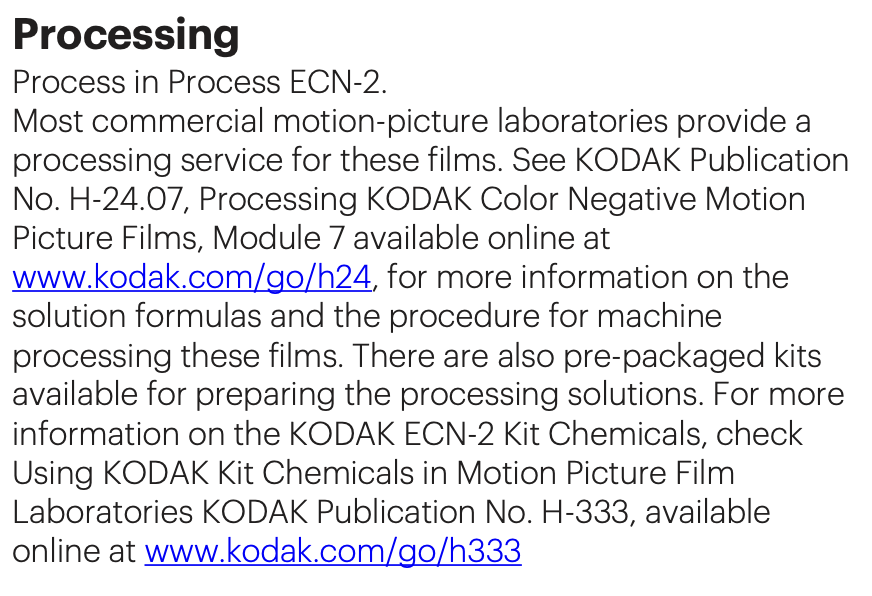
Kodak's official processing documentation specifies ECN-2 as the intended development process for VISION3 motion-picture colour negative films. Its CD-3 chemistry is designed to produce the emulsion's intended dye densities, contrast and colour response. This technical distinction underpins Liquid Light Lab's dedicated ECN-2 processing workflow and explains why C-41, which uses CD-4, produces different negative characteristics.
The characteristics described above depend on the film being processed appropriately. Kodak VISION3 is engineered for ECN-2 colour-negative development. This process uses the CD-3 colour-developing agent within a defined chemical system designed to produce the film's intended dye image, contrast and density relationships.
Conventional C-41 processing uses CD-4 and a different development specification. When a compatible VISION3-derived film is developed in C-41, it can produce a usable colour negative, but its colour and contrast characteristics differ from those obtained through ECN-2. For some photographers, this is a valid and deliberate choice. For other photographers seeking the native motion-picture negative characteristics of VISION3, ECN-2 remains the appropriate development process.
This isn’t simply a difference in how the photograph will be edited afterwards, because the chemical development choice made establishes the density and colour characteristics of the negative before scanning begins.
The differences between C-41 and ECN-2, including the colour-developing agents and their interactions with the emulsion, are examined in our companion article, C-41 and ECN-2 Are Not Alternatives: Why Film Development Chemistry Matters.
Remjet, AHU and Modern VISION3 Film
Traditional Kodak VISION3 camera-negative films used a remjet backing. This layer provided anti-halation control and physical protection, and required appropriate removal during motion-picture processing. Kodak has since introduced a revised VISION3 construction using an anti-halation undercoat (AHU) in place of the conventional remjet backing.
This is an important development for still photographers using compatible cinema-derived films. Removing remjet changes the film's physical processing requirements, but it does not change the underlying colour-negative emulsion into a conventional C-41 material, and Kodak continues to specify ECN-2 as the intended development process for VISION3.
The distinction between the older and newer film constructions also matters for alternative processing techniques. For example, Kodak's AHU guidance explains that its silver-bearing anti-halation layer produces significantly increased density when conventional bleaching is omitted, which we examine that subject in Why Kodak VISION3 AHU Film Changes Bleach Bypass.
Liquid Light Lab's current ECN-2 postal service accepts compatible remjet-free cinema-derived films. Photographers should confirm their stock's construction and processing requirements before sending it to the lab.
Why Conventional Minilab Scanning Cannot Preserve the Full VISION3 Negative
Correct exposure and ECN-2 development establish the negative's photographic characteristics, and scanning determines how much of that information is carried into the digital image.
This is particularly important for modern cinema negatives, and the extended highlight latitude of VISION3 can produce substantial density in the negative's brightest recorded scene areas. These dense regions transmit comparatively little light during scanning, placing considerable demands on the capture system.
Conventional automated minilab scanners were designed primarily for high-volume photographic output. Their CCD sensors and associated electronics have finite usable dynamic range, limited by sensor charge capacity, electronic noise and the scanning system's optical performance. When the negative contains density differences beyond the scanner's usable capture range, those differences cannot be recovered through subsequent editing. This is a legacy hardware limitation, not simply a question of which colour correction settings the operator selects.
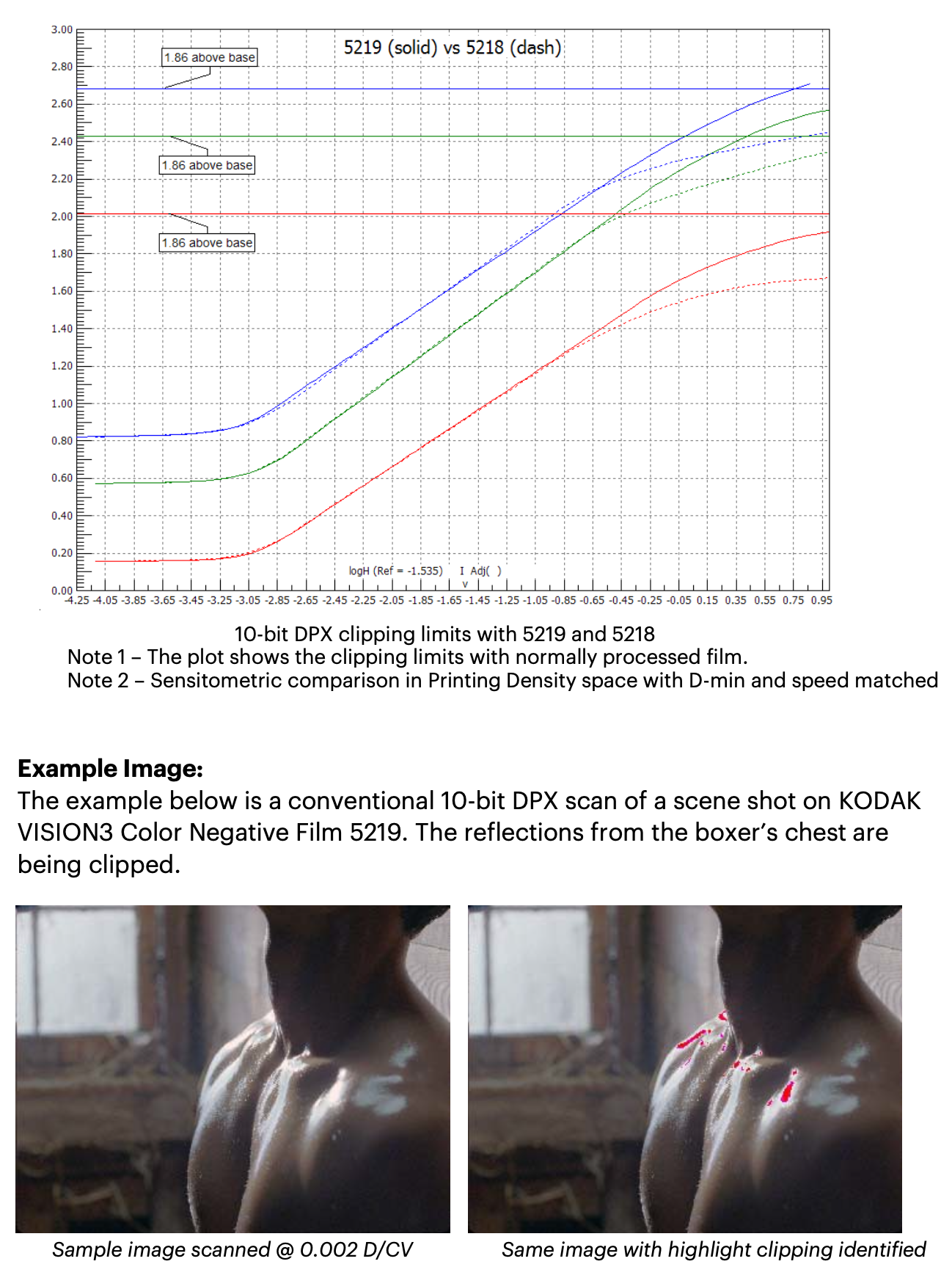
Kodak's technical research demonstrates how conventional 10-bit DPX scanning can clip highlight information recorded by VISION3 motion-picture negatives. The sensitometric curves and photographic examples illustrate where the scanning system's encoding limits prevent the full density range from being reproduced. Kodak recommends properly implemented 16-bit scanning to preserve this extended information, provided the capture hardware has sufficient dynamic range. This distinction is fundamental to Liquid Light Lab's approach to high-resolution cinema-negative digitisation.
Kodak's Own Scanning Recommendations
Kodak examined this problem in its technical paper, Scanning Recommendations for Extended Dynamic Range Camera Films, prepared with major motion-picture imaging and scanning companies. The paper explains that conventional 10-bit scanning encodings may fail to preserve the full density range recorded by VISION3 in scenes containing exceptionally bright information.
Kodak recommends extended-dynamic-range capture and identifies properly implemented 16-bit scanning as its preferred solution, provided the scanner's optical and electronic systems can measure the full range in the first place. The distinction is fundamental.
A 16-bit file cannot restore information that was lost at the capture stage.
Similarly, a scan with a large pixel count does not necessarily contain the tonal range recorded by the original negative. Resolution, dynamic range, bit depth and optical performance must be considered together.
This is why a modern cinema negative requires a scanning workflow capable of respecting its density characteristics rather than automatically forcing it into the limitations of a conventional minilab output system.
How Liquid Light Lab Scans VISION3
At Liquid Light Lab, we combine precision macro optics, controlled illumination, accurate film positioning and high-resolution capture. The objective is to record the detail, density relationships and tonal transitions available in the negative before preparing the final positive image.
Our standard 35mm development-and-scanning packages produce images of approximately 60 megapixels, with both full-resolution JPEGs and 16-bit TIFF files included.
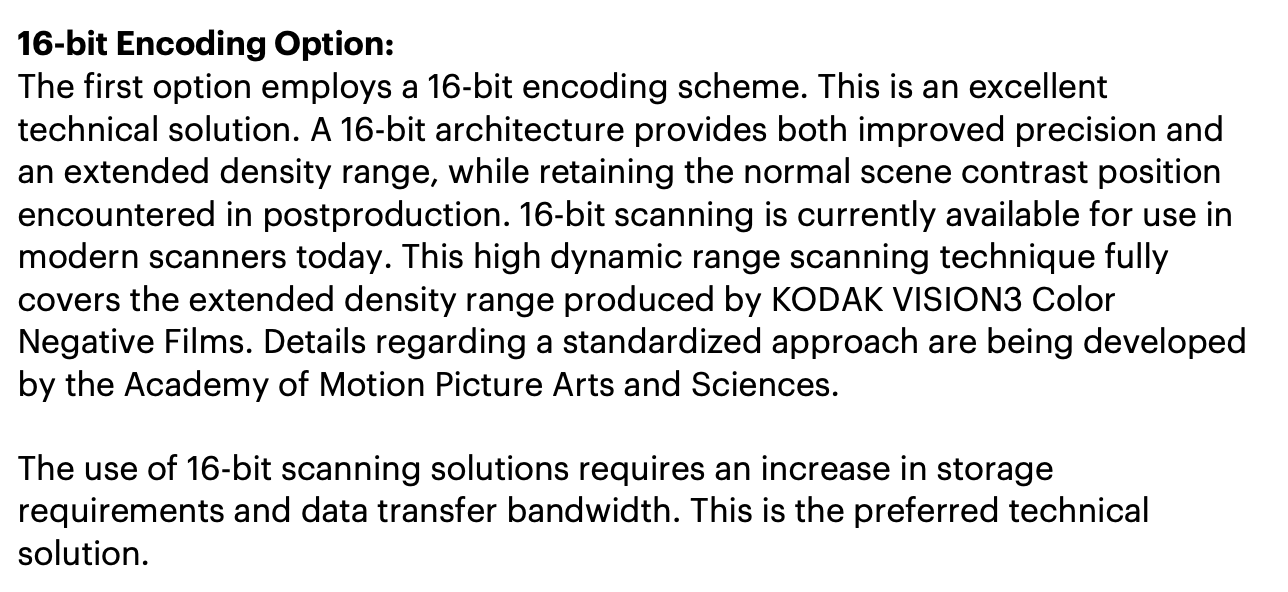
Kodak's scanning guidance identifies 16-bit encoding as the preferred technical approach for digitising VISION3 motion-picture negatives, as it preserves the extended density range these films are designed to record. At Liquid Light Lab, this underpins why our scanning packages include 16-bit TIFF files alongside full-resolution JPEGs.
The two formats serve different purposes for you. JPEGs provide convenient images for viewing, sharing and printing.
The 16-bit TIFF files offer greater tonal precision during further editing and grading, particularly where smooth transitions and substantial colour adjustments are involved.
The advantage is not simply numerical. A photograph containing gradual changes of illumination across skin, subtle differences in reflected light or fine variations within a highlight depends on the quality of the underlying capture and the precision of the subsequent digital workflow.
These are important characteristics when working with VISION3's extended-latitude negatives. The negative should provide a strong foundation for grading, rather than require post-production to reconstruct information lost through inadequate scanning.
Our broader approach to film scanning, including its relationship to museum and gallery digitisation, is explained in Why Film Scans Look Different From One Film Lab to Another.
From the Negative to the Finished Photograph
There is a useful distinction between a technically accurate scan and a photograph prepared for final presentation. The negative contains the recorded photographic information. Development establishes the resulting dye image and its density characteristics. Scanning captures that information digitally. Colour grading then determines how those recorded relationships are presented. Contrast may be increased or reduced. Colour balance may be adjusted. Highlight placement, shadow depth and the relationships between individual colours may be refined.
These are creative decisions, and VISION3's photographic characteristics make it attractive precisely because those decisions can be made after exposure and development, provided the necessary information has been preserved.
Grading should not be confused with the recovery of information that no longer exists in the scan. A capable scanning workflow allows the photographer to make creative choices from the information recorded by the negative. This is the relationship between motion-picture film and digital colour grading that makes VISION3 so useful to still photographers.
Professional Photography, Film Testing and Technical Expertise
Liquid Light Lab's experience with motion-picture film extends beyond processing customer orders. We remain practising professional photographers, working with film in studio, location and commissioned photographic environments. Our understanding of VISION3 is informed by the same exposure, lighting and lens decisions that photographers make when working with these films themselves.
This experience also contributes to our international technical partnership with Candido Collective. Our work includes film evaluation, exposure recommendations, technical data sheets and the instructions supplied with Candido films. Through this work, Liquid Light Lab contributes directly to the technical knowledge used by photographers, retailers, professional film laboratories and specialist scanning facilities worldwide, helping shape how Cinema films are understood, exposed, developed and digitised.
The relationship is explored further in Candido Film & Liquid Light Lab: Inside Our International Technical Partnership.
This combination of professional photographic practice and technical work is important. We understand how a negative is created, what its characteristics mean and what is required to reproduce it faithfully, and these principles inform our approach to ECN-2 development and high-resolution scanning.
Kodak VISION3 and ECN-2 Film Development at Liquid Light Lab
For photographers choosing Kodak VISION3-derived films, the development and scanning process should support the characteristics that made the emulsion worth selecting in the first place.
Liquid Light Lab provides professional ECN-2 processing for compatible remjet-free cinema-negative films through our UK-wide postal service.
Our dedicated ECN-2 workflow is supported by high-resolution scanning, with JPEG and 16-bit TIFF delivery included in all scanning packages. Photographers can choose development only, high-resolution scanning, additional image correction or professional editing according to their requirements.
Our work with Candido Collective, practical photographic experience and understanding of cinema-negative sensitometry all contribute to how these services are delivered.
Kodak VISION3 is worth choosing for more than its association with cinema. Its exposure latitude, tonal response and grading flexibility provide meaningful creative possibilities for still photographers working across many subjects and lighting conditions. The objective is to carry those possibilities through exposure, development and scanning, preserving the photographic decisions made when the image was first recorded.
Explore ECN-2 Film Development & Scanning at Liquid Light Lab
Explore All Film Developing Services
The Cinematic Notebook | Liquid Light Lab
Professional photography, film processing and photographic digitisation.