

At Liquid Light Lab, we took the AGO Film Processor beyond the occasional test roll, evaluating its performance across C-41, ECN-2 and black-and-white development using Zone Imaging's 510 Pyro. Our interest wasn't simply whether it could develop film, but whether its agitation, temperature compensation, chemical efficiency and mechanical operation could meet the demands of a professional processing environment.
The AGO promises something interesting: programmable rotary development in a compact system, with the flexibility to accommodate different emulsions, processing chemistry and working methods. But laboratory testing asks harder questions than a typical equipment review. How consistent are the results? How reliable is the mechanism? And what happens when something fails with irreplaceable negatives at stake?
This is our account of putting the AGO through real processing work, examining where the technology delivers, where its limitations become apparent, and what prolonged testing reveals about its suitability for a working film lab.
Affiliate disclosure: Liquid Light Lab is an affiliate partner of Vintage Visual and may earn a commission on purchases made through links in this article. Our review is based on extensive hands-on testing in a working film lab, covering both the AGO Film Processor's strengths and its limitations.
Save 10% on the AGO Film Processor and Vintage Visual store: Purchase directly from Vintage Visual and enter code THELIQUIDLIGHTLAB at checkout.
What the AGO Film Processor Actually Does
The AGO is a compact motorised processor designed to operate with compatible Paterson developing tanks. Rather than repeatedly inverting a tank by hand, it rotates the tank horizontally, providing a repeatable agitation pattern throughout the programmed processing stages.
Its other significant feature is active time compensation. The processor monitors chemical temperature and adjusts development time using its programmed compensation model. This is not active temperature regulation. The AGO does not heat or cool the processing solutions, and the operator remains responsible for preparing the chemistry at the correct starting temperature.
This distinction is particularly important when considering colour-negative development, where temperature, developer activity and processing time all contribute to the final negative. From a laboratory perspective, the principal attraction is the ability to define a processing programme and execute it consistently, rather than manually managing every agitation interval and timing adjustment.
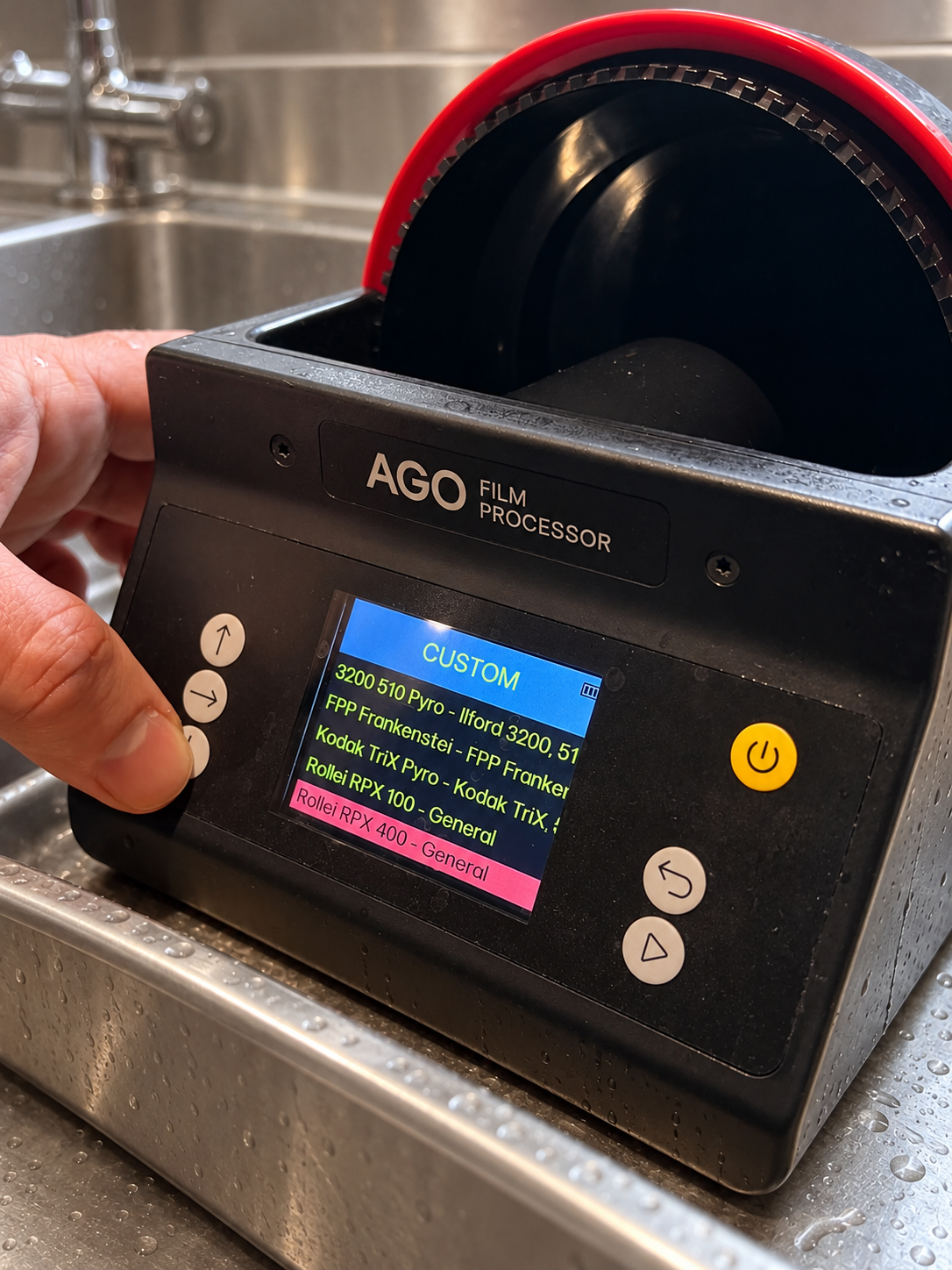
Building Programmes for Different Film and Chemistry
Liquid Light Lab's evaluation involved custom programmes for black-and-white development in 510 Pyro, C-41 colour negatives and ECN-2 motion-picture film. These are separate photographic processes with different chemical requirements, development characteristics and operational procedures.
The AGO permits the operator to configure processing stages, times, agitation and temperature compensation. Different black-and-white films can have dedicated development programmes, while push and pull processing variations can be stored independently. This quickly becomes especially useful when moving between films requiring substantially different development times.
A saved programme provides a repeatable operating sequence, but the programme itself must first be established correctly. Changing from manual inversion to continuous rotary agitation may require development-time adjustments, and those adjustments should be evaluated against the resulting negatives.
The equipment automates execution, but it does not determine the appropriate development for a particular film or substitute for knowledge of the chemistry.
Developing Black-and-White Film in 510 Pyro
510 Pyro is the core developer used in our black-and-white film development service. As a staining developer, its performance needs to be considered in terms of development activity, agitation, density and the characteristics of the individual film stock. The AGO provides a useful operating environment for this process because agitation can be repeated consistently, while film-specific development times remain available through individual programmes.
Our evaluation included different 510 Pyro configurations and a range of black-and-white emulsions. The resulting negatives provided useful evidence of repeatability, particularly during longer development cycles. Consistent rotation reduces one source of variation between successive runs, provided that chemical coverage, solution volume and processing times have been correctly established.
The temperature-compensation function is also useful during extended processing. However, compensation must be appropriate to the particular developer and conditions; it should not be assumed that a generic temperature correction is automatically suitable for every film and dilution.
At the lab, the assessment of successful development extends beyond how attractive the resulting photograph looks. Negative density, development uniformity, staining behaviour and the ability to reproduce the recorded information during scanning are all relevant.
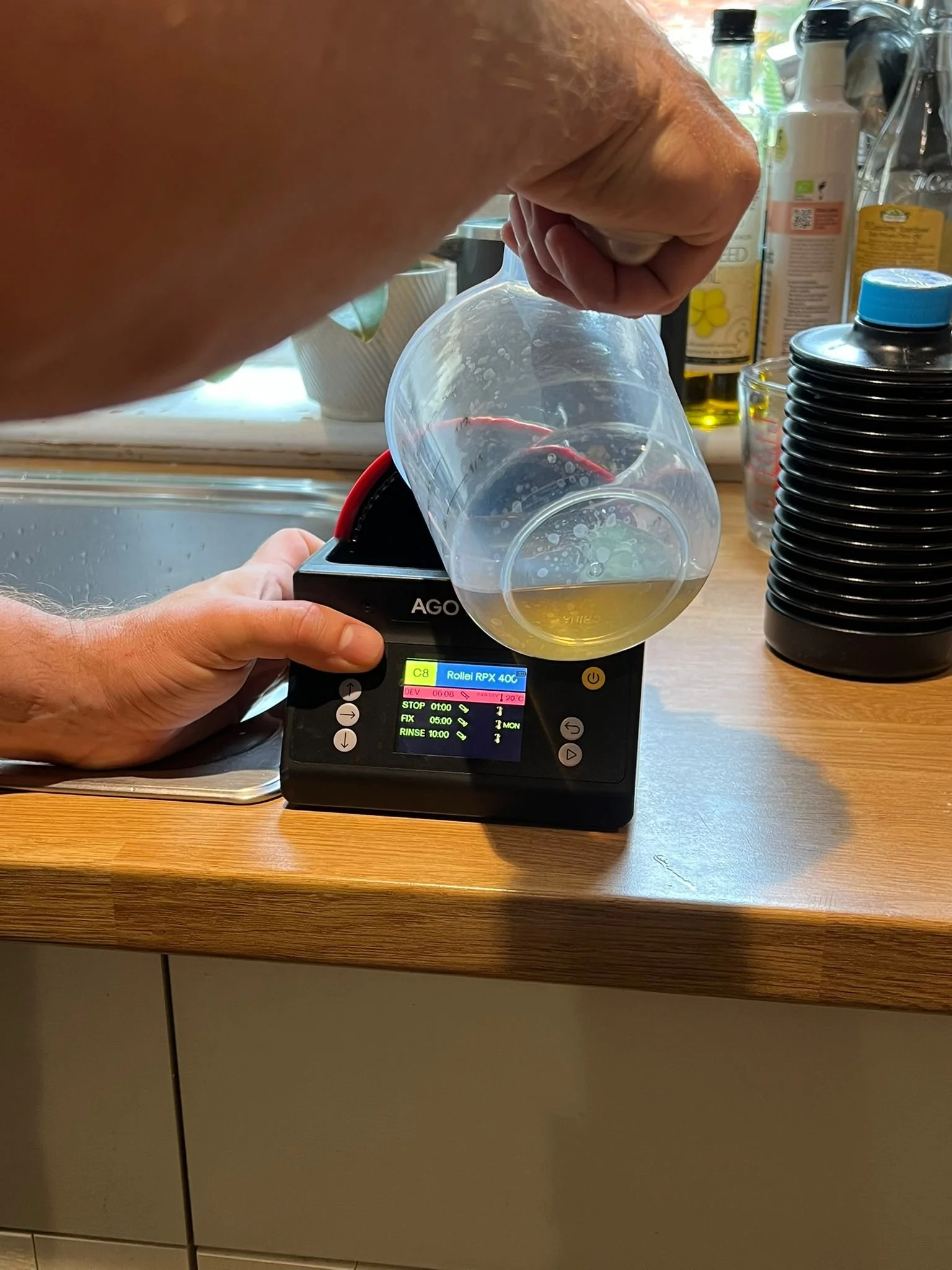
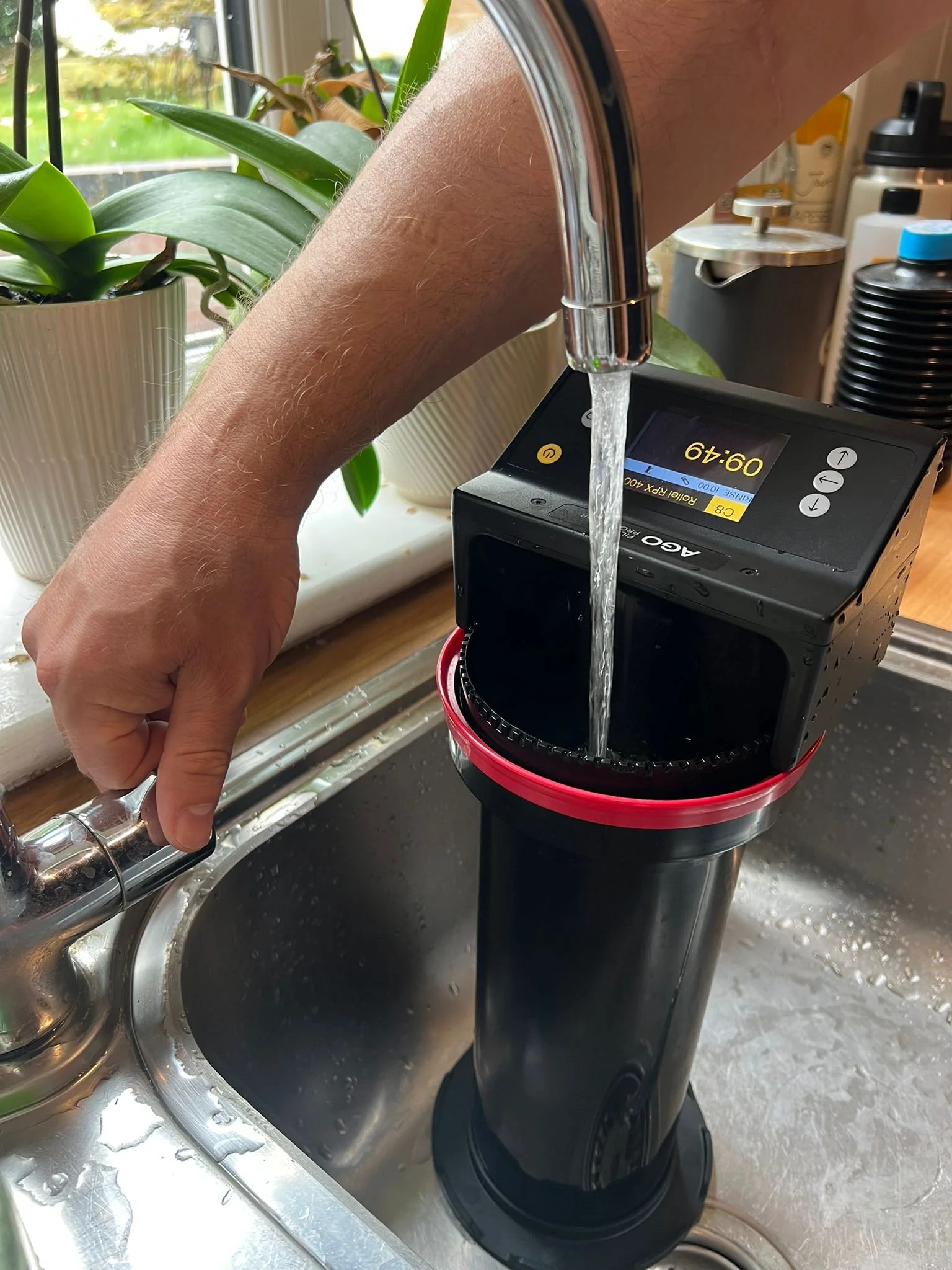
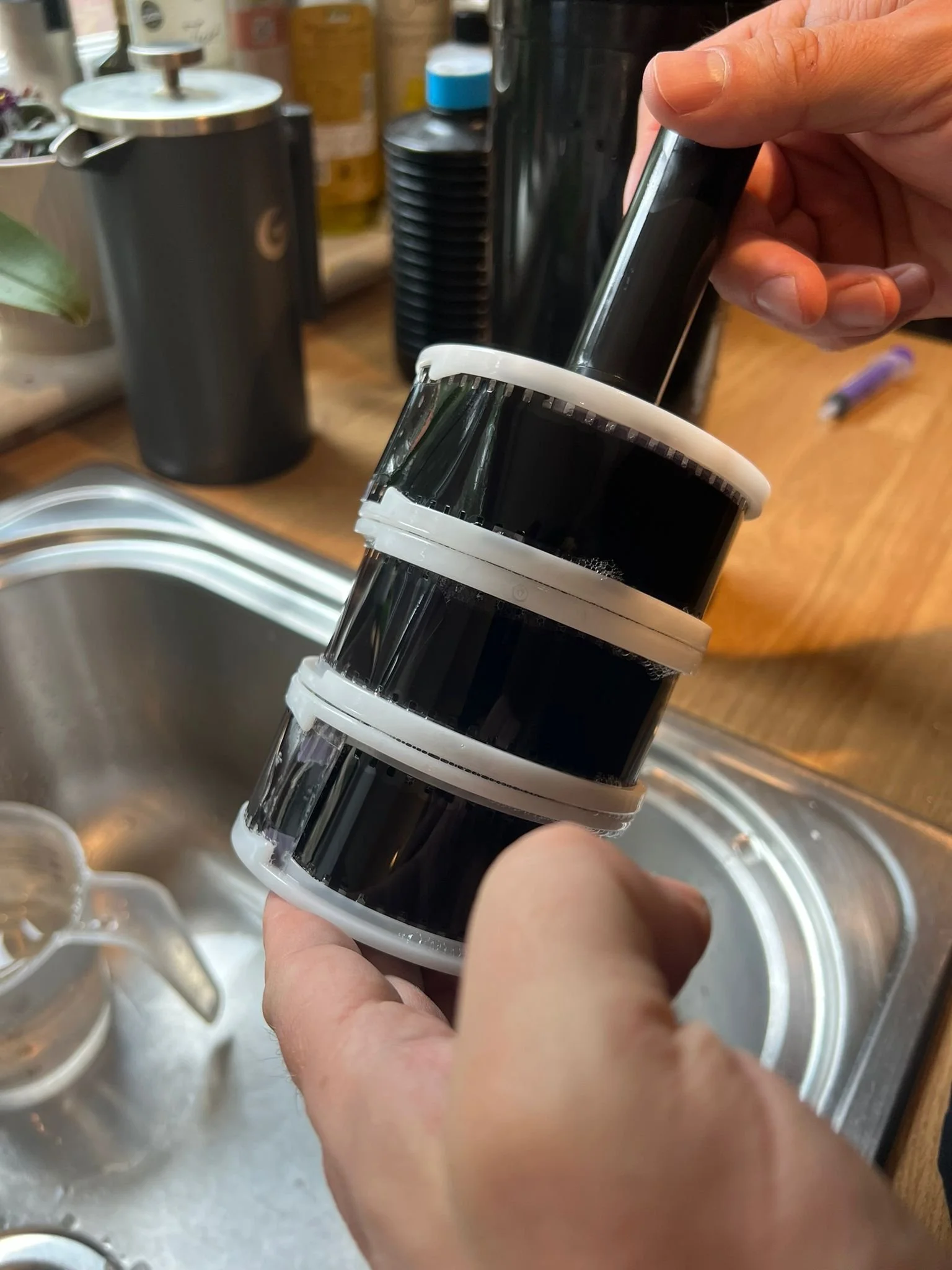
C-41 and ECN-2 Processing
The AGO's suitability for colour processing was another important part of our evaluation. C-41 and ECN-2 require different chemical systems. Although both produce colour negatives, their processing requirements cannot be treated as interchangeable. With appropriately configured programmes, the AGO provides controlled agitation and timed processing stages for either system. Temperature compensation is potentially useful as the working solution changes temperature during development. It does not remove the need for accurately prepared chemistry, correct process temperatures or established development procedures.
For pre-AHU ECN-2 film, rem-jet removal remains a separate processing consideration. The AGO's rotary mechanism does not replace the necessary preparation, removal and cleaning procedures.
Colour processing also demands attention to chemical condition, replenishment and contamination between stages. Those responsibilities remain with the operator regardless of how accurately the processor controls agitation and timing. Our assessment of the AGO has consequently focused on the repeatability of its mechanical operation and programmed stages rather than treating automation as a substitute for laboratory process control.
Chemical Economy and Processing Capacity
One of the practical advantages of rotary processing is the reduced quantity of working solution required for appropriate coverage of the film.
Vintage Visual specifies approximately 650ml for a five-reel Paterson tank and 950ml for an eight-reel configuration, using its rotary processing system. For a laboratory handling multiple rolls, these volumes are commercially interesting. Lower working volumes can reduce the amount of solution required during a processing run, particularly compared with filling the same tank for inversion development.
Working volume must not be confused with chemical capacity or replenishment requirements. The quantity of film that a developer can process remains governed by the chemistry's specifications, activity and replenishment regime. Liquid Light Lab evaluates chemical economy in those terms: the volume required to run a process, the capacity of the working solution and the consistency of the resulting negatives.
An economical process must remain chemically sound. Reduced solution consumption has little value if it introduces avoidable variation or reduces processing reliability.
What the Negatives Reveal

The strongest evidence of a processor's performance comes from the negatives it produces over repeated use. Our evaluation examined development uniformity, consistency across film strips, performance during extended development and the handling of both black-and-white and colour-negative material.
With the correct programmes and processing conditions established, the AGO produced consistent results across the workflows tested. The original negatives were subsequently digitised at Liquid Light Lab, allowing the results to be examined at high resolution.
Scanning is particularly useful when investigating development problems. Variations in negative density, uneven development and localised processing marks can become more apparent during detailed examination. It is equally important not to attribute every photographic characteristic to the processor. Film exposure, emulsion properties, developer activity and scanning technique all contribute to the finished image. We explore the influence of scanning decisions in why film scans look different from one lab to another.
The AGO's contribution is primarily the controlled execution of agitation and timing, not the creation of a particular photographic aesthetic.
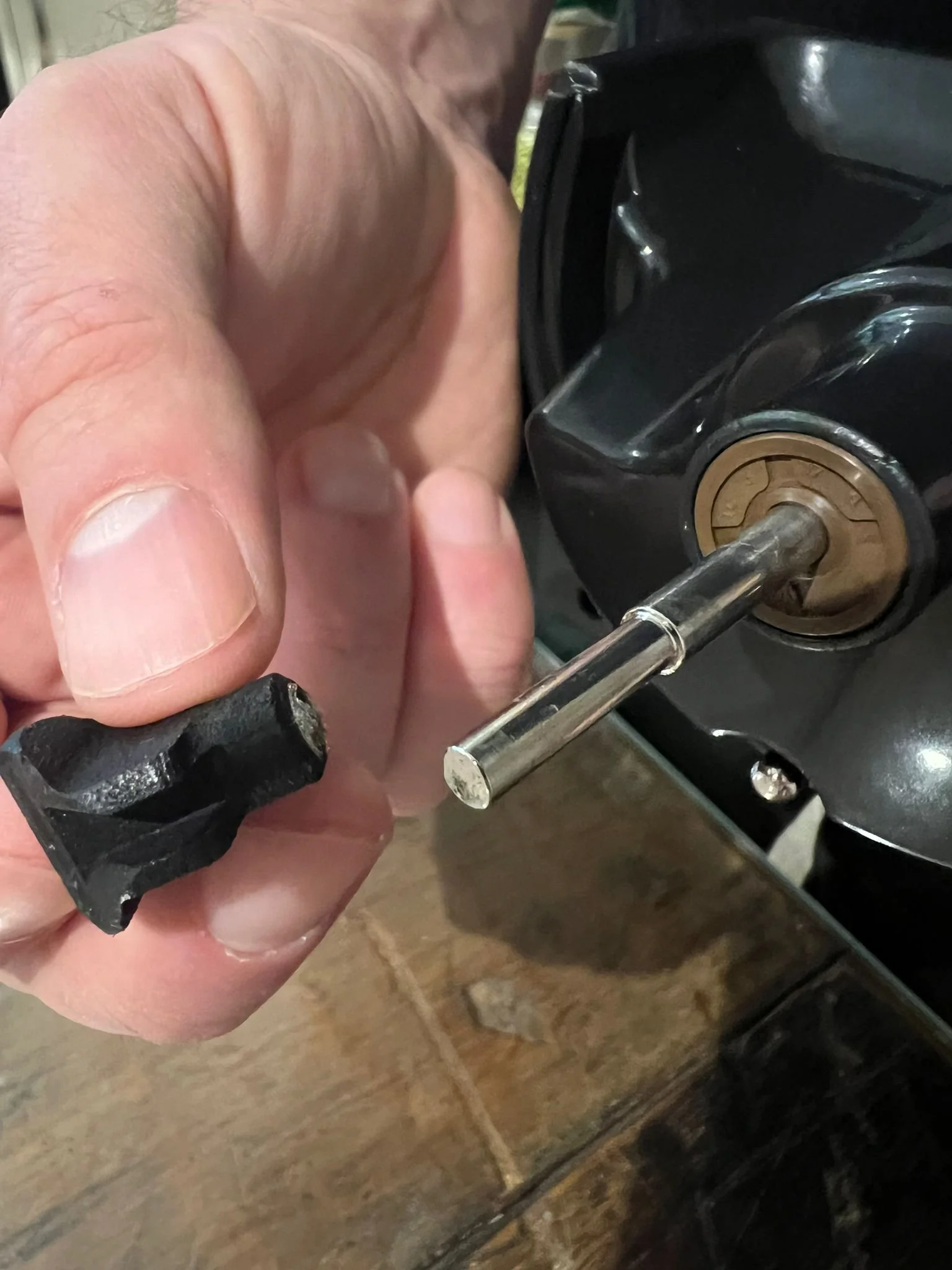
The AGO Film Processor's detached drive coupler, exposing the motor shaft following a mechanical failure during testing. The coupler is responsible for transferring rotation to the developing tank. Its failure highlights the importance of mechanical reliability.
Reliability: The Drive Coupler Failure
Not every aspect of our testing was positive.
During early use, the AGO's drive coupler became detached. The component is responsible for transmitting rotation to the developing tank, making its reliability essential. A failure during development can leave the film stationary in the working solution, with the potential for uneven development and permanently affected negatives. The original unit required an improvised repair, and subsequent extended evaluation included a replacement processor.
The failure was a significant concern because mechanical reliability is a fundamental requirement of professional film processing. A small component can have consequences far beyond its apparent importance when an exposed film is already immersed in developer.
This experience did not invalidate the processing results obtained from the AGO, but it remains an important part of our assessment. Any professional application of the system must take account of equipment inspection, operational monitoring and the consequences of mechanical failure.
Programming, Operation and Practical Limitations
The AGO's programming interface is functional rather than particularly intuitive. Once established, individual programmes are straightforward to select and repeat. Creating them initially requires care, especially when accounting for different films, processing stages and development adjustments.
The system also requires manual handling of chemistry between stages. It is not an automated chemical-mixing, dispensing or replenishment system. It also does not provide integrated heating, drying or independent chemical analysis.
These limitations do not necessarily diminish its usefulness, though they establish its proper role within a wider processing workflow.
For laboratories working with modest batches, specialist emulsions or multiple dedicated processing programmes, the compact format can be advantageous. Larger industrial workflows have different requirements concerning throughput, chemical management and redundancy.
Our evaluation has been concerned with the AGO's performance within an established processing environment, rather than suggesting it replaces every other form of film-processing equipment.
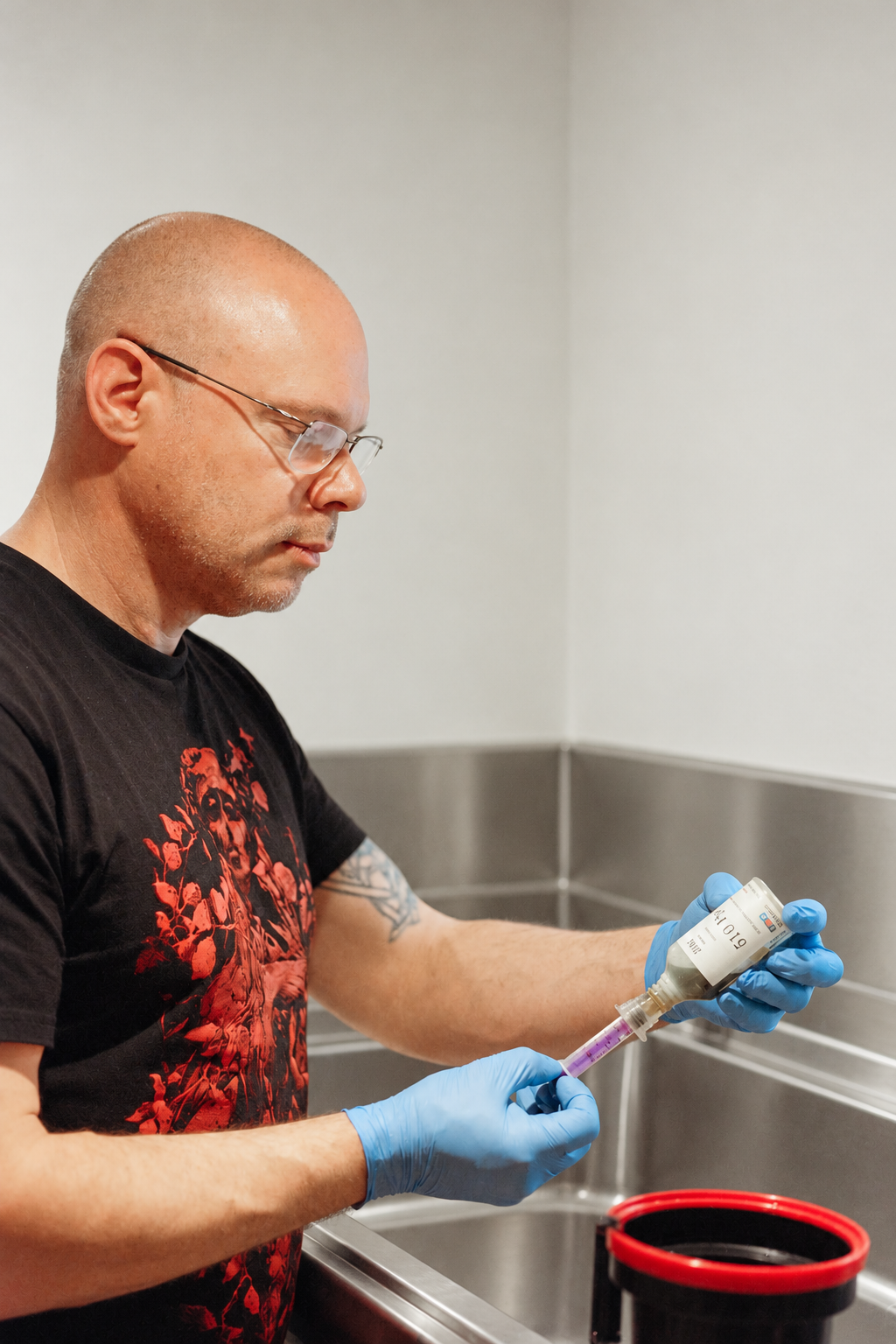
Preparing Zone Imaging 510 Pyro during our evaluation of the AGO Film Processor.
Our Assessment of the AGO Film Processor
The AGO is a capable compact rotary film processor with several features of genuine value to a working lab and home users alike. Its programmable agitation and development stages provide a repeatable mechanical process. Temperature-based timing adjustments can be helpful when correctly configured, and the reduced working volumes offer practical advantages for appropriately managed chemistry.
For black-and-white development, including 510 Pyro, the ability to maintain distinct programmes for individual films and processing variations is particularly useful. C-41 and ECN-2 processing also benefit from consistent mechanical execution, although their chemical and temperature requirements remain entirely separate responsibilities.
The most significant weakness encountered during our evaluation was mechanical reliability at the drive coupling. That failure deserves acknowledgement alongside the positive results, particularly because film development is irreversible.
Our overall assessment is favourable. The AGO offers a useful combination of programmability, compact construction and rotary processing capability, provided it is operated with properly established development procedures and realistic expectations about what the machine controls.
Professional results arise from the complete workflow: film handling, chemistry, process design, temperature, agitation, inspection and scanning. The AGO can contribute to that workflow, but it does not replace it. Our film handling and processing workflow explains how these responsibilities fit together at Liquid Light Lab, from identifying each roll and confirming its processing requirements to inspecting negatives, preparing scans and returning film.
Purchasing the AGO Film Processor
Liquid Light Lab works with Vintage Visual and participates in its affiliate programme. Photographers, educators and laboratories considering the AGO can find the equipment and associated accessories through our affiliate link:
Explore the AGO Film Processor at Vintage Visual
Discount code: THELIQUIDLIGHTLAB
This code is a 10% discount at the entire Vintage Visual store.
Purchases through the affiliate link may generate a commission.
The Cinematic Notebook | Liquid Light Lab